
Scope mount height is one of the most misunderstood topics in rifle setup. Shooters agonise over glass quality and reticle choice, then pick their mounts based on a single word — “low”, “medium”, or “high” printed on the packaging. The result is predictable: objective bells resting on barrels, bolt handles striking eyepieces, and scopes perched so high that a proper cheek weld becomes impossible.
Here is the uncomfortable truth: choosing the correct height matters far more than choosing between “low”, “medium”, or “high”, because those labels are not standardised and mean something different at every manufacturer. The only reliable way to select a mount is with actual dimensions in millimetres or inches.
In this guide, you will learn exactly what scope mount height is, how the two key measurements (BH and H) work, what determines the height your setup actually needs, how much clearance is enough, and how to verify everything before spending a single euro or dollar. Throughout the article, we will also show how the Optics Trade 3D Scope Mount Configurator turns what used to be a frustrating trial-and-error process into a few minutes of visual verification.

What Is Scope Mount Height?
Definition
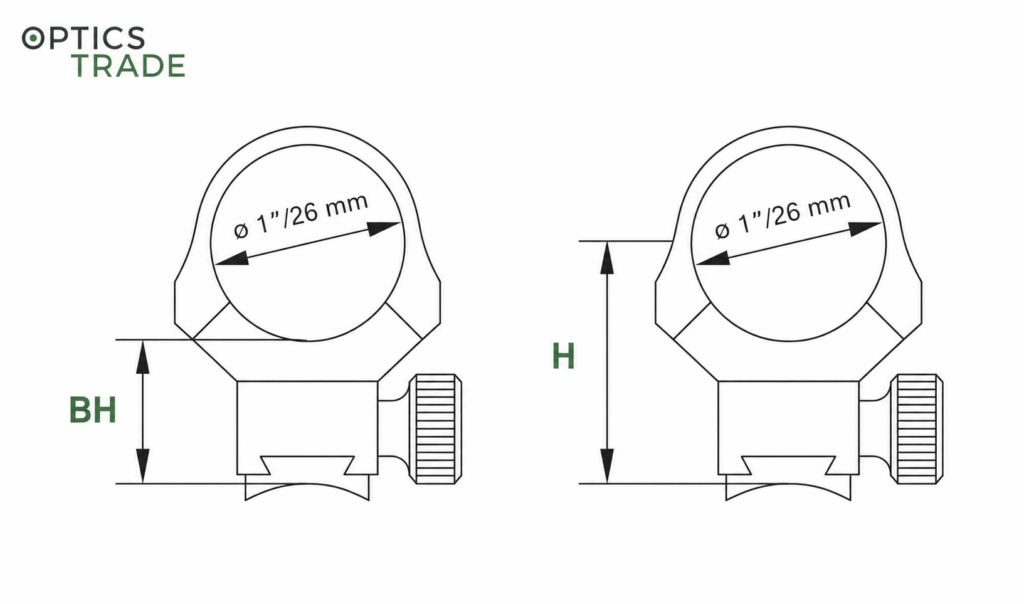
Scope mount height describes how far above the rifle the scope sits. Two measurements are used, and it is critical never to confuse them:
- Height (H) — the distance from the top of the mounting rail or base to the centreline of the scope tube. On rifles where no separate base or rail is used (proprietary interfaces and mounts that clamp directly onto the receiver), H is measured from the mounting surface on the rifle itself to the centreline. This is the measurement most commonly quoted by American manufacturers.
- Build Height (BH) — the distance from the mounting surface to the lower surface of the riflescope’s tube (the bottom of the ring saddle). This is the measurement preferred by most European manufacturers.
The relationship between the two is simple: H = BH + half of the scope’s main tube diameter. For a 30 mm tube, H = BH + 15 mm (0.59 in).
Why Different Manufacturers Measure Height Differently
Unfortunately, there is no single industry convention, and manufacturers quote whichever measurement suits their catalogue:
- Centerline height — from the rail to the tube centre (this is H). Common with American ring makers.
- Saddle height — from the rail to the bottom of the ring saddle (this is BH). Common with European mount makers such as Recknagel, EAW, and INNOMOUNT.
- Ring height — some brands measure from the bottom of the ring base, others from the top of the rail slot, and a few from the receiver surface below the rail. The reference point itself moves.
This is why two mounts both listed as “9 mm” can position the same scope at visibly different heights; the numbers describe different distances measured from different reference points. Measurements from different manufacturers cannot always be compared directly; you must first establish whether the figure is BH, H, or something else entirely. For a deeper dive into European mount dimensions, see our article on BH (height) and KR (extension) in scope mounts.
Why Scope Height Matters
Barrel Clearance
The most obvious reason: the objective bell must not touch the barrel. Under recoil, barrel harmonics and thermal expansion can cause a scope resting on the barrel to shift zero and can be permanently damaged. Mount height is the primary variable that creates (or eliminates) this clearance. The preferred gap is 2–4 mm (0.08–0.16 in) between the lowest point of the objective bell and the barrel — more if you use flip-up lens covers (see the clearance section below for details).
Bolt Handle Clearance
On turn-bolt rifles, the bolt handle sweeps an arc past the ocular bell on every cycle — and mount height is what creates (or removes) that gap. A scope mounted too low can block the action entirely: the handle strikes the eyepiece before the bolt opens fully. The bolt opening angle (a 90-degree throw swings the handle much closer to the ocular than a 54-degree throw) and the size and shape of the bolt handle or its ball/knob determine exactly how much height the handle demands.
Recoil Management
The scope must sit where your eye naturally lands when you mount the rifle. A scope mounted too high forces you to lift your head off the comb — and with it, often the whole rifle — until the stock ends up below the shoulder instead of seated firmly in the shoulder pocket. With only partial buttpad contact, the rifle kicks harder, muzzle rise increases, and follow-up shots get slower. Mount height is therefore not only a clearance question but a recoil management question — and in some shooting positions, a high-mounted scope makes recoil noticeably worse.
Neck Fatigue
The second half of shooting comfort is neck fatigue. With the scope at the correct height, your head rests its weight on the comb and the neck muscles relax. With a scope mounted too high, the head floats above the comb, held up by neck muscles alone — tiring during a long session at the range, and genuinely draining during hours of waiting in a high seat. A tired neck is also an inconsistent neck: as the muscles fatigue, the head position drifts, and with it your point of impact.
Eye Relief
Eye relief is usually discussed as a fore-aft adjustment, but height affects it too: if your eye sits below the optical axis because the scope is too high, you will see shadowing and vignetting no matter how carefully the fore-aft position was set. Correct height puts your eye on the optical axis automatically when your cheek rests on the comb.
Ballistics Calculations
Mount height is a direct input into every ballistic calculation. The sight height (height over bore — the distance from the bore centreline to the optical axis) determines how the trajectory intersects the line of sight: it shifts the near zero, the far zero, and every holdover in between. Enter the wrong sight height into a ballistic calculator and the output is wrong at every distance — the error is largest up close, which is exactly why high-mounted AR setups shoot noticeably low at room distances. If you change your mount height, you must update your ballistic profile and re-zero.
Rifle Balance
A scope is often the heaviest accessory on a hunting rifle. Mounting it higher raises the centre of gravity, which makes the rifle feel more top-heavy and slower to swing — a real disadvantage on driven hunts and offhand shooting.
Appearance
Finally, there is the matter of looks. A scope hovering far above the receiver on stilt-like mounts simply looks wrong — and in our experience, a rifle that looks wrong usually shoots wrong too, because the visual gap is a symptom of a broken cheek weld.
CONFIGURATOR TIP
See the Difference Before You Buy
With the Optics Trade 3D Scope Mount Configurator, you can see exactly how changing mount height affects rifle appearance and scope position before purchasing — on your rifle model, with your scope, in real 3D geometry.
Why “Low”, “Medium” and “High” Mean Almost Nothing
No Industry Standard
There is no industry standard behind these words. No committee ever defined what “medium” means in millimetres. Each manufacturer divides its own product range into three or four tiers and names them — which means the labels only describe a mount’s position within one catalogue, not its actual dimension.
Examples from Different Manufacturers
Real-world catalogues make the problem obvious. One American ring maker’s “low” ring measures an H of about 19 mm (0.75 in); another brand’s “low” is closer to 21 mm (0.83 in) — taller than a third brand’s “medium”. A European manufacturer may list the same physical height as “BH 6” with no descriptive name at all. One manufacturer’s “medium” is another’s “high”, and the same label can even mean a different dimension within a single product line, depending on ring diameter.
Always Compare Actual Measurements
The conclusion is simple: ignore the names, compare the numbers. Before buying any mount, find the actual BH or H value in millimetres or inches — and confirm which of the two it is. The only good method to designate the height of rings or scope mounts is with dimensions, never with marketing categories.
CONFIGURATOR TIP
Numbers, Not Marketing Terms
Instead of relying on marketing terms, the Optics Trade 3D Configurator lets you compare actual mount heights on your rifle — every mount in the system is modelled with its real BH dimension, so what you see is what you get.
The Two Measurements You Need to Know
Build Height (BH)
BH (Build Height) is the distance from the mounting surface of the rifle (the top of the rail or base) to the lowest point of the scope tube. Because it is independent of tube diameter, BH describes the mount itself — a BH 6 mm mount lifts every scope tube exactly 6 mm above the rail, whether the tube is 25.4 mm or 36 mm.
BH is the measurement preferred in Europe for a practical reason: the EU market has many railed scopes — models with a Zeiss ZM/VM, Swarovski SR, or Schmidt & Bender Convex rail integrated into the scope body instead of a round tube. On a railed scope there is no tube for the rings to grip, so H is not straightforward: the “centreline” depends on a tube-equivalent convention that varies between rail systems. BH, measured simply from the rifle’s mounting surface to the underside of the scope (tube or rail), works identically for both tube scopes and railed scopes — which is why European manufacturers standardised on it.
Height (H)
H (Height) is the distance from the mounting surface to the centreline of the scope tube — the optical axis. H is what actually determines your line of sight above the bore, but it is only meaningful together with a stated tube diameter, because the centre of a fat tube sits higher than the centre of a slim one in the same rings.
Converting Between BH and H
The conversion is always the same: H = BH + (tube diameter ÷ 2). Unless stated otherwise, all H values in this article are calculated for scopes with a 30 mm main tube — the most common diameter on modern European scopes — so H = BH + 15 mm (0.59 in). Here is the full conversion for every common tube size:
| Tube Diameter | Half Tube | Conversion | Example: BH 6 mm → |
|---|---|---|---|
| 1 inch (25.4 mm) | 12.7 mm (0.5 in) | H = BH + 12.7 mm | H 18.7 mm (0.74 in) |
| 30 mm | 15 mm (0.59 in) | H = BH + 15 mm | H 21 mm (0.83 in) |
| 34 mm | 17 mm (0.67 in) | H = BH + 17 mm | H 23 mm (0.91 in) |
| 35 mm | 17.5 mm (0.69 in) | H = BH + 17.5 mm | H 23.5 mm (0.93 in) |
| 36 mm | 18 mm (0.71 in) | H = BH + 18 mm | H 24 mm (0.94 in) |
| 40 mm (railed scopes) | 20 mm (0.79 in) | H = BH + 20 mm | H 26 mm (1.02 in) |
The 40 mm row deserves a note: it applies to railed scopes. Many European premium riflescopes carry an integrated rail on the scope body — the Zeiss ZM/VM rail, the Swarovski SR rail (with its 40 mm tube-equivalent clamping surface), or the Schmidt & Bender Convex rail. These scopes cannot use rings at all; they require dedicated scope mounts for railed scopes, and their mount heights are specified with the same BH logic described here.
OPTICS TRADE 3D CONFIGURATOR
Build Your Setup with Confidence
Planning a new rifle setup? Use the Optics Trade 3D Configurator to verify scope mount compatibility, check clearances, and visualize your complete setup before purchasing. The configurator helps you avoid costly mounting mistakes and ensures every component fits together correctly.

What Determines the Required Mount Height?
Objective Lens Diameter
The number in the scope’s name — the “56” in a 3-12×56 — is the diameter of the glass, not of the scope. A larger objective needs the optical axis further from the barrel, so objective diameter sets the baseline for required height. But it is only the starting point.
Actual Outside Diameter
What actually has to clear the barrel is the objective bell’s outside diameter — the glass plus the housing around it. This is typically 6–10 mm (0.24–0.4 in) larger than the lens diameter: a 56 mm objective usually lives in a bell of 62–65 mm. Calculating clearance from the lens diameter alone is one of the most common sources of “too low” purchases.
Scope Tube Diameter
Tube diameter changes the BH-to-H conversion. For the same H (same optical axis height), a 34 mm tube needs a lower BH than a 30 mm tube, because more of the height is taken up by the tube itself.
Rifle Action
The type of action can completely change the mount height you need:
- Straight-pull bolt-action rifles (Blaser R8, Merkel RX Helix, Strasser RS 14) — the bolt handle travels straight back without rotating upward, so the scope can be mounted really low over the receiver.
- Traditional (turn-bolt) rifles — the bolt opening angle is decisive: a bolt with a 90-degree opening angle swings the handle much closer to the ocular bell than one with a 54-degree opening angle, and these two designs change completely how high your ocular has to be.
- Semi-automatic rifles — the mount and scope must not interfere with case ejection, which can force the optic higher or further forward.
Rail Type
The rail itself adds height above the receiver — and different rails add different amounts. A Picatinny rail typically raises the mounting surface several millimetres above where an 11 mm dovetail machined into the receiver would sit. A 20 MOA canted rail changes the height at the front and rear ring positions by different amounts. And proprietary interfaces (Blaser saddle, Sauer ISI, Sako dovetail) each define their own baseline geometry.
Barrel Profile
A pencil-profile mountain barrel drops away quickly under the objective bell; a straight bull or varmint barrel stays thick exactly where the objective needs space. Two rifles with the same rail and the same scope can need completely different mount heights purely because of barrel contour. This is covered in depth in our companion article on how the rifle determines the right ring height.
Bolt Handle Clearance
On turn-bolt rifles the handle sweeps an arc past the ocular bell on every cycle. The size and shape of the bolt handle — and especially of the ball or knob at its end — together with the opening angle of the bolt determine exactly how much space it needs. An oversized tactical knob can demand a taller mount even when the objective bell has clearance to spare.
Lens Covers
Flip-up lens covers wrap around the objective bell, adding roughly 2–4 mm (0.08–0.16 in) to its effective outside diameter — plus the hinge, which usually sits at the bottom or side. A setup with 2 mm of barrel clearance has zero clearance once a cover is installed.
Sunshades
A screw-in sunshade extends the objective bell forward — often over a thicker, less tapered section of the barrel, or over a front sight or gas block. The clearance you measured at the objective position may not exist 50–100 mm further forward.
Clip-on Devices
Thermal and night vision clip-on devices attach in front of the objective and have a significantly larger body diameter than the scope’s bell — plus an adapter that adds more. If you plan to run a clip-on now or in the future, its diameter (not the scope’s) defines the required clearance. The same logic applies to silencers: an over-barrel (reflex) silencer extends back over the barrel with a much larger diameter than the barrel itself and can eliminate the clearance under the objective bell or a forward-mounted clip-on.
Do not forget rear clip-on devices either — night vision attachments like the Pard NV007 or scope cameras like the TriggerCam that mount onto the eyepiece. These devices add bulk directly in the path of the bolt handle, so with any rear clip-on the mount height usually has to be higher for the bolt handle to keep enough clearance on its way up.
Stock-to-Optical-Axis Distance
Finally, consider the distance between the stock and the optical axis. The comb supports your head, and your eye needs to land on the axis without straining — which means there must be enough vertical space between the two. This is exactly why AR rifles need higher mounts: the straight-line stock sits high relative to the bore, and without some space between the stock and the optical axis you would have to push your head and cheek down onto the stock to see through the scope — an uncomfortable, tiring, and inconsistent position. The right mount height keeps your head upright and relaxed on the comb, with the eye falling naturally onto the axis.
CONFIGURATOR FEATURE
All Variables, Considered Automatically
Keeping ten variables in your head is exactly the problem the Optics Trade 3D Scope Mount Configurator was built to solve. It automatically considers:
Lens covers are also taken into account where the data is available. Every dimension in the system is the real, manufacturer-verified geometry — not a catalogue approximation.

The Lowest Possible Mount Is Not Always the Best
Why Lower Became the Standard
“Mount it as low as possible” became the default advice for good reasons: a lower scope keeps the line of sight close to the bore (simplifying trajectory at mixed distances), preserves a natural cheek weld on classic stock combs, keeps the centre of gravity down, and simply suits the geometry of traditional hunting rifles.
When Lower Is Better
For a classic bolt-action hunting rifle with a fixed comb and a scope of moderate objective size, the rule holds: the best mount is the lowest one that clears every contact point — objective bell, bolt handle, and scope belly. On such rifles that typically means a BH of around 5–8 mm (0.2–0.3 in), an H of roughly 20–23 mm (0.79–0.91 in) with a 30 mm tube.
When Higher Is Better
There are, however, situations where a taller mount is the objectively correct choice:
- AR platforms — the flat-top receiver and stock geometry are designed around an optical centreline of roughly 35–39 mm (1.39–1.54 in) above the rail; a “hunting-low” mount on an AR puts your nose on the charging handle. See our articles on absolute and lower 1/3 co-witness and cantilever mounts.
- Thermal clip-ons — the clip-on body diameter is far larger than the objective bell; the scope must sit high enough for the device to clear the barrel.
- Night vision — the same clearance logic as thermal, plus head-position considerations when shooting with an NV attachment behind or in front of the optic.
- Large bolt handles — oversized tactical knobs on precision rifles frequently require one step taller mounts than the objective bell alone would.
- Better ergonomics — on rifles with adjustable combs or for shooters with longer necks, a slightly taller mount can produce a more upright, more repeatable head position, particularly in positional shooting.
CONFIGURATOR EXAMPLE
Same Scope, Three Heights
Try this in the configurator: mount the same scope in BH 14 mm, BH 17 mm and BH 20 mm (H 29, 32 and 35 mm with a 30 mm tube). You will see the objective clearance grow, the bolt handle gap open up — and the scope climb further and further from the comb. The right answer for your rifle sits exactly where all clearances are met and not one millimetre higher.
Finding the Ideal Height
Check Barrel Clearance
Verify the gap between the objective bell’s outside diameter (plus lens cover, if used) and the barrel at the exact position where the bell will sit — accounting for the barrel’s taper at that point.
Check Bolt Clearance
Trace the full arc of the bolt handle — including the knob — and confirm it passes the ocular bell without contact at the peak of its rotation, not just at rest.
Check Eye Position
With the rifle mounted naturally, your eye should land on the optical axis — a full, shadow-free image without lifting or pressing your head.
Check Cheek Weld
Your cheek must rest firmly on the comb while looking through the scope, and the buttpad must sit fully in the shoulder pocket. If reaching the sight picture pulls the stock below your shoulder, the mount is too tall for this stock — or the comb needs to be raised.
Verify Everything Before Buying
All four checks must pass simultaneously. The traditional way to do this is to buy a mount, install everything, discover a problem, return it, and try again — expensive in both time and restocking hassle.
OPTICS TRADE EXCLUSIVE
Instead of Manual Trial and Error
The Optics Trade 3D Scope Mount Configurator performs all of these checks visually before ordering, dramatically reducing the risk of purchasing the wrong mount. Select your rifle model and riflescope to instantly verify:
You can even move every component inside the assembly exactly as it would be adjusted in real life before purchasing. The entire process takes only a few minutes.

How Much Clearance Is Enough?
Barrel Clearance
Our recommendation: 2–4 mm (0.08–0.16 in) between the lowest point of the objective bell and the barrel. The absolute minimum for a bare scope is 1–2 mm — enough to survive recoil movement and barrel harmonics — but 2–4 mm gives you a comfortable margin for the real world: dust covers, temperature swings, and the accessory you have not bought yet.
Lens Covers
If you use flip-up covers, add their material thickness — typically 2–4 mm (0.08–0.16 in) — to the required clearance, and check where the hinge sits. A cover with a bottom hinge effectively doubles the needed gap.
Thermal Expansion
A barrel heats up during a long string of fire and physically grows in diameter and length, and it also vibrates through its harmonic pattern with every shot. Clearance that exists on a cold, still barrel can vanish on a hot one — another reason the 2–4 mm recommendation beats the bare minimum.
Future Accessories
Think one purchase ahead. A clip-on thermal, a sunshade, or an over-barrel silencer added next season can turn a perfectly clearanced setup into a contact problem. If any of these are on your horizon, factor their dimensions into the mount height decision now — changing mounts later usually means re-zeroing and sometimes new rings entirely.
OPTICS TRADE 3D CONFIGURATOR
Build Your Setup with Confidence
Planning a new rifle setup? Use the Optics Trade 3D Configurator to verify scope mount compatibility, check clearances, and visualize your complete setup before purchasing. The configurator helps you avoid costly mounting mistakes and ensures every component fits together correctly.
Scope Height on Different Rifle Types
Hunting Rifles
Classic bolt-action hunting rifles with sporter barrels take the lowest workable mounts — typically a BH of 5–8 mm (0.2–0.3 in), an H of roughly 20–23 mm (0.79–0.91 in) with a 30 mm tube. Fast, instinctive mounting and a rock-solid cheek weld matter more here than on any other platform. On European rifles, remember that many premium scopes are railed (Zeiss ZM/VM, Swarovski SR, S&B Convex) and take dedicated railed scope mounts with the same BH logic.
Precision Rifles
Heavy barrels, large 56 mm objectives, 34 mm tubes, oversized bolt knobs, and 20 MOA rails all push precision rifles toward taller mounts — a BH of 10–14 mm (0.4–0.55 in), an H of roughly 25–29 mm (0.98–1.14 in) with a 30 mm tube (lower BH for the same H on 34 mm tubes), is a common landing zone. Adjustable combs make the extra height ergonomically painless.
Tactical Rifles
Tactical bolt guns and semi-autos often add night vision or thermal clip-ons, backup iron sights, and full-length Picatinny rails. Heights are chosen for system compatibility rather than minimalism — the clip-on’s body diameter frequently dictates the mount, not the scope.
AR-15
The AR-15 is the exception that proves every rule: its flat-top rail sits high above the bore and its straight-line stock demands an optical centreline of about 35–39 mm (1.39–1.54 in) above the rail. Red dot heights are described by co-witness standard, and magnified optics ride in cantilever mounts that push the scope forward for correct eye relief.
Dangerous Game Rifles
On dangerous game rifles, the scope sits as low as physically possible: a low optic keeps the rifle pointable like a shotgun and lets the shooter’s eye fall instantly on target at close range. Small-objective low-magnification scopes (or railed driven-hunt scopes) make very low BH values achievable — but watch the bolt handle, since magnum actions often wear large, hand-filling handles, and watch recoil: on a .416 or .458, a compromised cheek weld and a stock riding below the shoulder are punished immediately.
Scope Height and Shooting Position
Bench Shooting
At the bench, the rifle is supported and your head position is deliberate, so a slightly taller mount is tolerable — which is exactly why so many height mistakes go unnoticed until the rifle leaves the bench. Never judge a mount height by bench comfort alone.
Hunting
Hunting is shot standing, kneeling, from high seats and shooting sticks — fast and unrehearsed. Here a low mount earns its keep: the scope is exactly where your eye lands, the stock stays fully in the shoulder, and recoil is controlled. A mount that is too tall shows up as slow target acquisition and a rifle that kicks harder than it should, because the stock slides below the shoulder pocket.
PRS
PRS shooters build positions on barricades, rooftops and props, with the head more upright than in classic prone. Many deliberately run mounts a step taller — with the adjustable comb raised to match — because an upright head position is faster to replicate across improvised positions. The key is that comb height and mount height move together.
Long-Range Shooting
In prone long-range work, consistency is everything: an inconsistent head position means inconsistent parallax and reticle alignment, and errors invisible at 100 m become measurable dispersion at 500 m and beyond. The ideal height is whatever lets your cheek return to precisely the same spot on the comb, shot after shot — verified with the comb adjusted so your eye centres in the scope naturally.
Common Mistakes
- Buying “Low” rings because the word sounds right — without checking what “low” measures in that particular catalogue.
- Ignoring the outside objective diameter — calculating clearance from the lens size (e.g. 56 mm) instead of the bell’s true outside diameter (often 62–65 mm).
- Forgetting lens covers — the 2–4 mm a flip-up cover adds is exactly the clearance many setups have left.
- Ignoring bolt handle clearance — checking only the objective and discovering at the range that the bolt knob strikes the eyepiece.
- Mixing BH and H — comparing one manufacturer’s BH 9 against another’s H 9 and wondering why the scopes sit 15 mm apart.
- Assuming every manufacturer measures the same way — reference points differ; always confirm what a listed number actually describes.
- Buying unnecessarily tall rings “just to be safe” — the safety is an illusion: you trade imaginary clearance problems for very real cheek weld, recoil and consistency problems.
CONFIGURATOR TIP
Catch Mistakes Before They Cost Money
Most of these mistakes can be identified visually before ordering. In the 3D Configurator, a mount that is too low shows the collision immediately, BH and H are never mixed up because the geometry is modelled, and lens cover and clip-on dimensions are part of the calculation.
Can You Calculate the Correct Height Yourself?
Manual Formula
Yes — in principle. The minimum required height follows from simple geometry:
Minimum H = (objective outside diameter ÷ 2) + required clearance − distance from the rail top down to the barrel surface at the objective position
and then BH = H − (tube diameter ÷ 2). If the barrel surface sits below the rail plane, the last term is positive and reduces the required height; on heavy barrels that rise close to the rail plane, it shrinks toward zero.
Required Measurements
- Objective bell outside diameter — measured with a calliper, not read from the scope’s name
- Main tube diameter — for the BH conversion
- Rail-to-barrel distance at the objective position — the hard one, because of barrel taper
- Desired clearance — 2–4 mm (0.08–0.16 in), plus lens cover thickness if applicable
Why Manual Calculations Become Difficult
The formula is easy; the inputs are not. In practice the calculation breaks down on:
- Barrel taper — the rail-to-barrel distance changes continuously along the barrel, and the objective position depends on eye relief, which you have not set yet.
- Rail height — factory rails, aftermarket rails and canted (20 MOA) rails all place the mounting surface at different heights, sometimes different at front and rear.
- Receiver geometry — round receivers, flat-tops and integral bases each define the reference plane differently.
- Objective outside diameter — rarely published; without the scope in hand you are guessing.
- Mount geometry — ring spacing, cantilever offset and base thickness all shift where the scope actually sits.
Manual Calculation vs 3D Simulation
| Method | What It Checks | Accuracy | Effort |
|---|---|---|---|
| Calculator (formula) | One clearance point | Only as good as your inputs | Low, but inputs are hard to get |
| Ruler/calliper on the rifle | One clearance point, roughly | ±1–2 mm at best | Requires scope and rifle in hand |
| CAD drawing | All geometry — if you model it | High | Hours of modelling per combination |
| Optics Trade 3D Scope Mount Configurator | All clearances, collisions, positions | Manufacturer-verified geometry | A few minutes, no hardware needed |
Why Use the Optics Trade 3D Scope Mount Configurator?
Built Specifically for Scope Mount Selection
The configurator is not a generic 3D viewer — it was built specifically for scope mount selection, around exactly the problem this article describes: too many interacting variables for a chart, a formula, or a guess.
What It Calculates Automatically
- Correct mount height for your rifle-and-scope combination
- Barrel clearance using the actual barrel profile of your rifle model
- Objective clearance from the true outside diameter of the bell
- Bolt clearance along the handle’s full arc
- Scope position including eye relief travel within the rings
- Rail compatibility between rifle, base and mount
- Mount compatibility — including railed scope mounts for ZM/VM, SR and Convex rail scopes
Interactive 3D Visualization
You can rotate the rifle, zoom in on any contact point, inspect clearances with live measurements, and compare different mounts side by side — exactly as you would on the workbench, minus the workbench.
Saves Time and Money
Every wrong mount is a return shipment, a restocking delay, and a rifle that sits in the safe unfinished. Verifying the setup digitally reduces returns, prevents incompatible purchases, and eliminates guesswork — for free, before checkout.
Billions of Supported Combinations
The system models billions of supported combinations — all possible combinations of rifles, rails, mounts, scopes and accessories, multiplied by every possible position of each component within the assembly, run into the billions. From a Tikka T3x with a railed Swarovski to an AR-15 with a cantilever LPVO — and the database grows continuously.
OPTICS TRADE 3D CONFIGURATOR
Build Your Setup with Confidence
Planning a new rifle setup? Use the Optics Trade 3D Configurator to verify scope mount compatibility, check clearances, and visualize your complete setup before purchasing. The configurator helps you avoid costly mounting mistakes and ensures every component fits together correctly.
Frequently Asked Questions
Can a scope be mounted too low?
Yes. A scope mounted too low contacts the barrel with its objective bell (or lens cover), blocks the bolt handle’s arc, or rests its belly on the rail or rings. Any metal-to-metal contact will shift zero under recoil and can permanently damage the scope. The mount must clear every contact point — objective, bolt handle, and scope belly — with margin.
Can it be mounted too high?
Yes, and this mistake is more common than mounting too low. A scope mounted too high breaks the cheek weld, forces the head up until the stock slides below the shoulder, worsens felt recoil and muzzle rise, raises the centre of gravity, and introduces head-position inconsistency that shows up as dispersion at longer distances.
Does tube diameter affect height?
Yes, in two ways. First, it changes the BH-to-H conversion: H = BH + half the tube diameter, so the same BH mount puts a 34 mm tube’s optical axis 2 mm higher than a 30 mm tube’s. Second, ring inner diameter must match the tube exactly — 30 mm rings cannot hold a 34 mm tube at any height.
Does objective diameter determine height?
It sets the baseline, but it does not determine the answer alone. The objective bell’s outside diameter (larger than the lens), the barrel profile at the objective position, the rail height, the bolt handle, lens covers and clip-on devices all move the required height up or down. Two rifles can need completely different mounts for the same 56 mm objective.
What is BH?
BH (Build Height) is the distance from the rifle’s mounting surface to the lower surface of the riflescope’s tube — the bottom of the ring saddle. It describes the mount itself, independent of tube diameter, and is the standard measurement used by European mount manufacturers.
What is H?
H (Height) is the distance from the mounting surface to the centreline of the scope tube — the optical axis. H equals BH plus half the main tube diameter; for the common 30 mm tube, H = BH + 15 mm (0.59 in).
Should the objective almost touch the barrel?
No. “As low as possible” means as low as possible while keeping proper clearance — not paper-thin gaps. Under recoil and barrel heat, an objective that almost touches will eventually touch. Keep 2–4 mm (0.08–0.16 in), more if you use lens covers.
How much clearance is ideal?
2–4 mm (0.08–0.16 in) between the objective bell’s lowest point and the barrel is the ideal working range: enough for recoil movement, barrel harmonics and thermal expansion, with margin for flip-up covers. The absolute minimum for a bare scope is 1–2 mm; going below that is not safe.
Can I reuse my rings?
Only if three things still match: the tube diameter of the new scope, the rail standard of the rifle, and the height requirement of the new combination. A new scope with a larger objective bell or a fatter tube usually means new rings — and rings that were lapped or epoxy-bedded to a previous scope tube should not be reused for a precision setup.
Which mount height should I buy?
The lowest one — expressed in millimetres or inches, never in marketing labels — that clears the objective bell (plus covers), the bolt handle’s full arc, and the scope belly on your specific rifle, while your cheek stays firmly on the comb. The fastest way to find that exact number is the Optics Trade 3D Scope Mount Configurator.
OPTICS TRADE 3D CONFIGURATOR
Build Your Setup with Confidence
Planning a new rifle setup? Use the Optics Trade 3D Configurator to verify scope mount compatibility, check clearances, and visualize your complete setup before purchasing. The configurator helps you avoid costly mounting mistakes and ensures every component fits together correctly.
Scope Mount Height Chart
The chart below gives indicative starting values for a standard sporter-profile barrel with a factory rail or bases. It assumes the objective bell’s outside diameter is 6–10 mm larger than the lens. Important: a chart cannot see your barrel contour, rail height, bolt handle or comb — treat these numbers as a starting point and verify the final choice on your actual rifle in the 3D Configurator.
| Objective Lens | Typical Bell OD | Indicative BH | Indicative H (30 mm tube) |
|---|---|---|---|
| up to 36 mm | 42–44 mm | 3–6 mm (0.12–0.24 in) | 18–21 mm (0.71–0.83 in) |
| 40–44 mm | 48–52 mm | 5–8 mm (0.2–0.31 in) | 20–23 mm (0.79–0.91 in) |
| 50 mm | 56–60 mm | 8–12 mm (0.31–0.47 in) | 23–27 mm (0.91–1.06 in) |
| 56 mm | 62–65 mm | 11–15 mm (0.43–0.59 in) | 26–30 mm (1.02–1.18 in) |
| Heavy/varmint barrel | any | add 2–5 mm to the above | add 2–5 mm to the above |
Scope Mount Height Calculator
To calculate the minimum height manually: Minimum H = (objective bell outside diameter ÷ 2) + clearance (2–4 mm) − rail-to-barrel distance at the objective position, then BH = H − (tube ÷ 2). Example: bell OD 62 mm, clearance 3 mm, barrel surface 22 mm below the rail top → H = 31 + 3 − 22 = 12 mm, BH = 12 − 15 = below zero, meaning even the lowest mount clears — until a heavy barrel or a clip-on changes the numbers. Because the rail-to-barrel distance is the input almost nobody can measure accurately, the practical “calculator” is the Optics Trade 3D Scope Mount Configurator, which already contains the real geometry of your rifle.
How to Measure Scope Mount Height
- Measuring BH on a mount: with a calliper, measure from the flat underside that contacts the rail (not the claw or cross-bolt) to the lowest point of the ring saddle.
- Measuring H on a mount: measure BH as above, then add half the ring’s inner diameter (half of the scope tube it accepts).
- Measuring on an assembled rifle: measure from the rail top to the bottom of the scope tube (that is BH) or to the centre of the turret axis (that is H). Never measure to the objective bell — the bell diameter is not the tube diameter.
BH vs H Conversion Table
| BH | H — 1″ tube | H — 30 mm | H — 34 mm | H — 36 mm |
|---|---|---|---|---|
| 3 mm | 15.7 mm | 18 mm | 20 mm | 21 mm |
| 6 mm | 18.7 mm | 21 mm | 23 mm | 24 mm |
| 9 mm | 21.7 mm | 24 mm | 26 mm | 27 mm |
| 12 mm | 24.7 mm | 27 mm | 29 mm | 30 mm |
| 15 mm | 27.7 mm | 30 mm | 32 mm | 33 mm |
| 20 mm | 32.7 mm | 35 mm | 37 mm | 38 mm |
Common Scope Tube Sizes
| Tube Diameter | Common On | Notes |
|---|---|---|
| 1 inch (25.4 mm) | Many American hunting scopes | Most common in the North American market |
| 30 mm | Most modern European and tactical scopes | Dominant in current production |
| 34 mm | High-end precision and competition scopes | Larger elevation adjustment range |
| 35 mm | Select Leupold and high-end scopes | Verify before purchasing rings |
| 36 mm | Select high-magnification European scopes | Less common; verify manufacturer spec |
| 40 mm | Railed scopes (Zeiss ZM/VM, Swarovski SR) | Use dedicated railed scope mounts — rings do not apply |
Recommended Clearances
| Check Point | Recommended | Absolute Minimum |
|---|---|---|
| Objective bell to barrel (bare scope) | 2–4 mm (0.08–0.16 in) | 1–2 mm (0.04–0.08 in) |
| Objective bell to barrel (with flip-up covers) | 4–7 mm (0.16–0.28 in) | 3–4 mm (0.12–0.16 in) |
| Bolt handle to ocular bell (full arc) | 3+ mm (0.12+ in) | visible daylight at the closest point |
| Scope belly to rail / rings | visible clearance along entire length | no contact at any point |
Related Articles
- How to Mount a Scope on a Rifle: The Complete Guide
- How to Choose the Right Ring Height for Your Rifle
- Scope Mounts — What Do BH (Height) and KR (Extension) Stand For?
- A Complete Guide to Riflescope Mount Interchangeability
- Screw Tightening Torque Values in Riflescope Mounting
- Zeiss ZM/VM Rifle Scope Mounting Rail
- Swarovski SR Rail Mounting of Rifle Scopes

