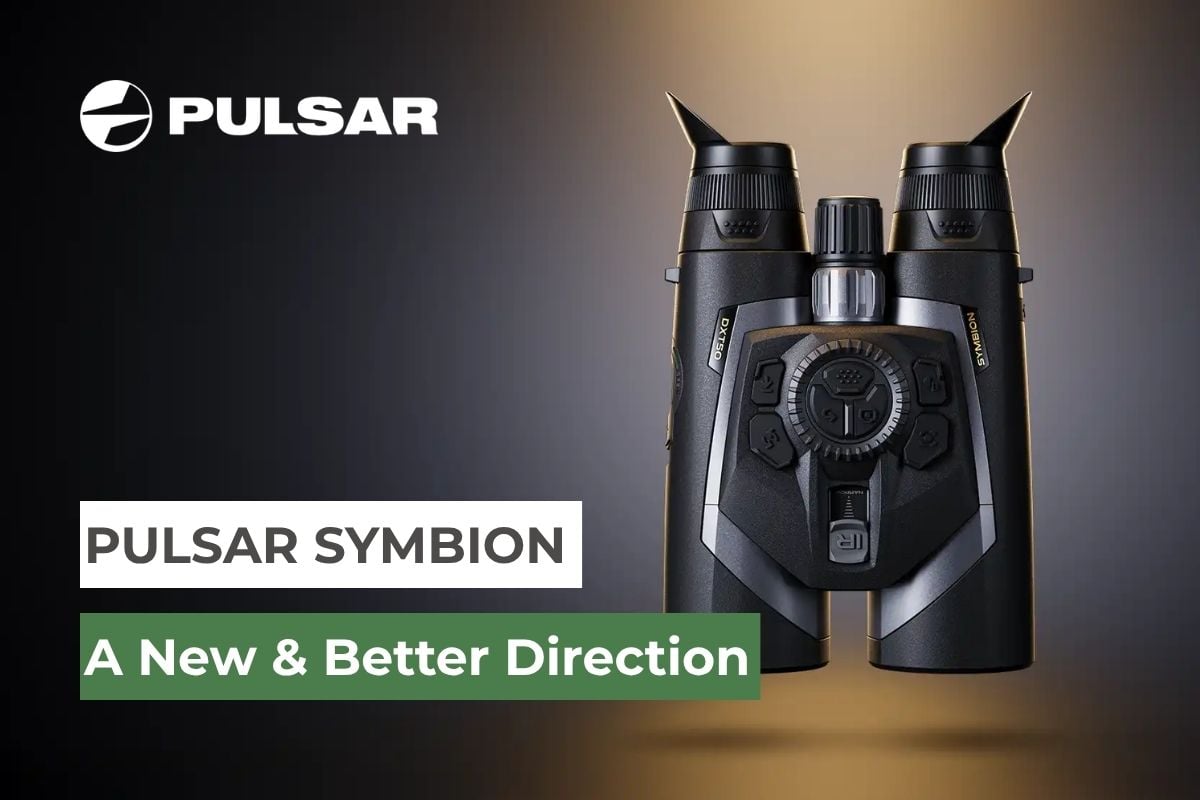
With the introduction of the Pulsar Symbion series, Pulsar is clearly redefining what a modern hunting optic should look and feel like. Rather than simply iterating on existing platforms such as the Pulsar Merger lineup, Symbion represents a noticeable shift in design philosophy, ergonomics, and overall usability.
From what we’ve seen so far we can confidently say this is Pulsar’s most refined attempt at combining thermal imaging, digital night vision, and full-color daytime observation into a single, compact binocular platform.

What Is the Pulsar Symbion LRF?
The Pulsar Symbion is a multispectral hunting binocular.
This means it does not rely on only one type of image. Instead, it gives the user several observation modes in one device:
- thermal image
- digital night vision
- daytime colour image
- laser rangefinding
Thermal imaging helps with detection. Digital night vision helps with identification. Daytime colour mode makes the device useful during the day. The laser rangefinder adds distance measurement. In practice, this gives hunters more options in the field. So, instead of carrying several separate devices, the hunter can use one binocular for most observation tasks.
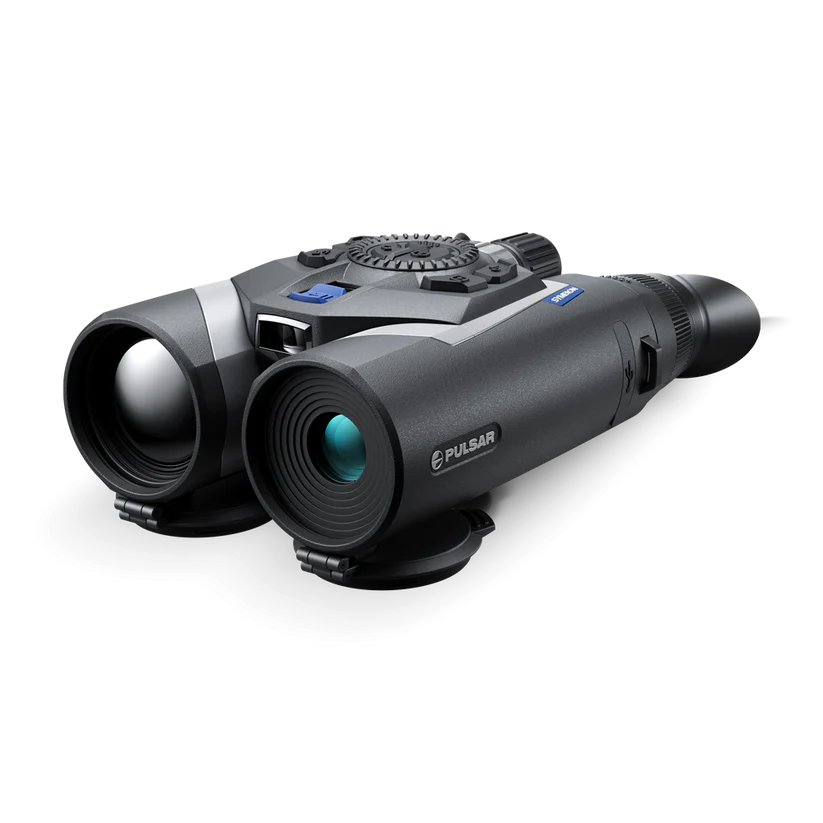


Pulsar Symbion’s Completely New Design Philosophy
Design and Ergonomics
One of the most striking aspects of the Symbion is its completely redesigned housing. Compared to earlier Pulsar devices, the Symbion feels:
- smaller
- cleaner
- better balanced
- easier to hold
- more modern
This matters more than it may sound. Hunters often use these devices for longer periods, especially when scanning fields, forest edges, or open terrain. If a binocular is too bulky or awkward to hold, you notice it quickly.
The button layout is also simple enough to use in the dark. You do not want to search for buttons when you are already in the field. You want to find them by feel, make the adjustment, and continue observing.

Rotary Control Dial
One of the best changes is the rotary control dial on top of the device.
This makes menu navigation easier. Instead of pressing buttons over and over again, you can scroll through the menu and settings in a more natural way. It is a small detail on paper, but in real use it can make a big difference. Especially at night, when you want to change settings quickly and without too much distraction.
Central Focusing System
Another good change is the central focusing system, placed between the eyepieces.
On many thermal or night vision devices, focusing is done with a ring on the front lens. That works, but it is not always comfortable, especially when you are holding the device with both hands.
With central focusing, adjustment is quicker and more natural. You do not have to move your hand to the front of the device every time you want to fine-tune the image.
For a hunting binocular, this is the better solution in our opinion.
Multispectral Capability in a Compact Form
The Pulsar Symbion LRF combines three main observation modes:
- Thermal imaging
- Digital night vision
- Full-colour daytime observation
Each mode has its own role.
Thermal imaging is used for detection. It helps you find animals quickly, even when they are partly hidden, standing near forest edges, or difficult to see with normal optics. Thermal is especially useful when the animal blends into the background or when visibility is poor.
Digital night vision is useful when you need more detail at night. Thermal image is excellent for finding heat sources, but it does not always show enough detail for identification. Digital night vision gives a more natural image and can help when you want to see more of the animal, the terrain, or the surroundings.
The full-colour daytime mode makes the Symbion useful during the day as well. This is important because it means the device is not limited to night hunting or low-light use. You can also use it as a daytime observation tool.
This combination is not entirely new. Pulsar already used a similar idea with the Merger DUO. But the key difference is size and practicality. The Symbion offers similar multispectral functionality in a noticeably smaller and more ergonomic package, which makes it better suited for hunters who move a lot or do not want to carry a larger binocular for several hours.
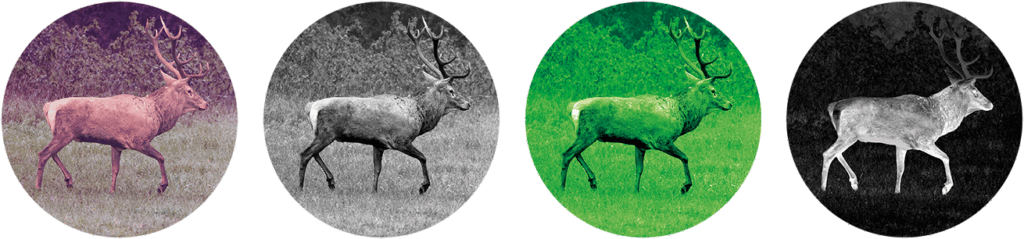
Pulsar Symbion LRF 4K Daytime Sensor
For daytime and digital observation, the Symbion uses a 4K full-colour CMOS sensor.
This should provide a detailed colour image during the day, but it also helps in low-light situations such as early morning, late evening, or twilight. These are exactly the times when hunters often need better visibility.
The 4K sensor is also important because it gives the device a more natural observation mode. Thermal is great for detection, but it is not always the best option when you want to observe detail. The colour sensor gives the Symbion a wider use case and makes it more useful outside purely thermal observation.
Built-in IR Illuminator on the Pulsar Symbion
For digital night vision, the Symbion also has a built-in IR illuminator.
A particularly useful detail is that the IR illuminator is focusable. This means you can adjust the beam depending on distance and conditions.
If you are observing at shorter distances, you do not need a narrow, strong beam. If you are observing farther away, a more focused beam can help. This gives the user more control and makes the digital night vision mode more flexible.
Many competing devices still do not offer a focusable IR illuminator, so this is a practical advantage.
Pulsar Symbion Thermal Performance
The thermal performance of the Symbion LRF is strong, but this is not where the whole story is.
Pulsar did not build this device only around a thermal sensor upgrade. The Symbion is more about integration, handling, and overall usability.
That is important to understand. If you compare only thermal performance, the Symbion may not look like a massive jump over some previous Pulsar devices. But if you look at the whole package, the device becomes much more interesting.
You get thermal detection, digital night vision, daytime colour image, laser rangefinding, better controls, central focusing, and a more compact body in one device.
This is similar to what Pulsar has been doing with the Merger series. The focus is not only on raw sensor numbers, but also on making the device more comfortable and practical for real use.
For many hunters, that is more important than one specification being slightly better on paper.
Pulsar Symbion Laser Rangefinder
Both Symbion models on the market today have a built-in laser rangefinder (LRF) with a measuring range of up to 1500 meters and an accuracy of ±1 meter.
For hunting, this is one of the most important features. Detecting an animal is useful, but knowing the distance is often just as important. This is especially true in open terrain, where distance can be difficult to judge by eye.
The LRF is actually one of the stronger parts of the Symbion series in our opinion. It performs well even in less ideal conditions, where some other rangefinders can struggle.
Pulsar Symbion LRF Battery System
The Symbion LRF uses two APS5 external batteries.
Depending on the model, battery life is around 8 to 10 hours. This is enough for most hunting situations, and the external battery setup makes the device easier to manage during longer sessions.
APS5 batteries can be replaced in the field, so you can carry spares if needed. This is also useful in cold weather, where battery performance usually drops faster.
Pulsar Symbion LRF User Interface and Controls
Pulsar also introduced a cleaner and more modern user interface with the Symbion.
The menu should be easier to understand and faster to navigate. Combined with the rotary control dial, this makes the whole device feel more natural to use.
This is an area where Pulsar has clearly improved over the years. Image quality is important, but controls and menu structure matter just as much in the field.

Available Models: DXT50 vs DXR50
Pulsar Symbion LRF DXT50: Wide Field Specialist
The Pulsar Symbion LRF DXT50 is the higher-end model in the series.
It is built around a 1280×1024 thermal sensor, which is the main reason for its higher price. It also has a wide field of view, making it better suited for scanning and general situational awareness.
Main specifications:
- Thermal sensor: 1280×1024, 12 µm
- Thermal magnification: 2–16x
- Field of view: 17.5°
- Field of view at 100 m: 30.7 m
- Detection range: 2300 m
- Laser rangefinder: up to 1500 m
- Battery life: around 8 hours
- Price: 5,590.00 €
The DXT50 is the better choice for hunters who often hunt in forests, mixed terrain, or areas where animals can appear at shorter or medium distances.

Pulsar Symbion LRF DXR50: Long-Range Model
The Pulsar Symbion LRF DXR50 is the more affordable model in the series.
It has a 640×480 thermal sensor, but it offers higher magnification than the DXT50. This makes it better suited for open terrain and longer-distance observation.
Main specifications:
- Thermal sensor: 640×480, 12 µm
- Thermal magnification: 4–32x
- Field of view: 8.8°
- Field of view at 100 m: 15.4 m
- Detection range: 2300 m
- Laser rangefinder: up to 1500 m
- Battery life: up to 10 hours
- Price: 3,990.00 €
The DXR50 makes more sense for hunters who mostly observe across fields, open terrain, mountains, or longer distances. The narrower field of view is not as comfortable for fast scanning, but the higher magnification is useful when distance matters more than overview.
It is also much cheaper than the DXT50, which will make it the more realistic choice for many users who want the Symbion concept but do not need the higher-resolution 1280×1024 thermal sensor.

Pulsar Symbion LRF DXT50 vs DXR50: What Is the Difference?
The main difference between the Pulsar Symbion LRF DXT50 and Pulsar Symbion LRF DXR50 is how they are optimized.
The DXT50 has the better thermal sensor and wider field of view. It is made for faster scanning, better overview, and stronger thermal detail.
The DXR50 has lower thermal resolution, but higher magnification, longer battery life, and a lower price. It is made more for longer-distance observation.
Choose the Pulsar Symbion LRF DXT50 if you want:
- higher thermal sensor resolution
- wider field of view
- faster scanning
- better situational awareness
- a model better suited for forests and mixed terrain
Choose the Pulsar Symbion LRF DXR50 if you want:
- higher magnification
- lower price
- longer battery life
- a model better suited for open terrain
- a more affordable entry into the Symbion LRF series
Neither model is simply “better” for everyone. They are made for different users.
If you scan a lot and hunt in mixed terrain, the DXT50 makes more sense. If you mostly observe over longer distances and want to keep the price lower, the DXR50 is probably the better choice.

Pulsar Symbion Price
The Pulsar Symbion series is positioned in the premium segment.
Current prices are:
- Pulsar Symbion LRF DXR50: 3,990.00 €
- Pulsar Symbion LRF DXT50: 5,590.00 €
The price difference is mainly connected to the thermal sensor and field of view.
With all being said, this pricing structure makes sense in our opinion. Pulsar is clearly separating the two models by intended use, not only by price.
Is the Pulsar Symbion LRF Good for Hunting?
The Pulsar Symbion is clearly made for hunting.
It can be used for:
- thermal detection
- night observation
- daytime observation
- identification
- distance measurement
- scanning fields
- scanning forest edges
- observing open terrain
Its biggest advantage is that it combines several tools in one device.
A hunter can use thermal to detect an animal, digital night vision or colour mode to see more detail, and the rangefinder to measure distance. This makes the Symbion useful in many different hunting situations.
The main question is not whether it is useful for hunting. It clearly is. The better question is whether you need this many features in one device.
If you only need thermal detection, a simpler thermal binocular may be enough. But if you want a more complete observation device, the Symbion is much more interesting.
Pulsar Symbion Pros and Cons
The main advantages of the Pulsar Symbion are:
- thermal imaging, digital night vision, and daytime colour image in one device
- built-in laser rangefinder
- compact binocular design
- improved ergonomics
- rotary control dial
- central focusing system
- focusable IR illuminator
- APS5 battery system
- two models for different hunting situations
Things to keep in mind:
- high price
- DXT50 is much more expensive than DXR50
- DXR50 has a narrower field of view
- DXT50 has shorter battery life
- hunters who only need thermal imaging may not need all features
The Symbion is not the cheapest or simplest solution. But that is not the point of the device. It is made for hunters who want one binocular that can handle several tasks.
Pulsar Symbion FAQ
What is the Pulsar Symbion?
The Pulsar Symbion is a multispectral hunting binocular. It combines thermal imaging, digital night vision, full-colour daytime observation, and a laser rangefinder in one device.
What is the difference between Pulsar Symbion LRF DXT50 and DXR50?
The DXT50 has a 1280×1024 thermal sensor and a wider field of view. The DXR50 has a 640×480 thermal sensor, higher magnification, longer battery life, and a lower price.
Does the Pulsar Symbion LRF have a laser rangefinder?
Yes. Both Pulsar Symbion LRF models have a built-in laser rangefinder with a measuring range of up to 1500 meters and ±1 meter accuracy.
What is the detection range of the Pulsar Symbion LRF?
Both Symbion LRF models have a detection range of up to 2300 meters.
How long does the Pulsar Symbion LRF battery last?
Battery life depends on the model. The DXT50 offers around 8 hours, while the DXR50 offers up to 10 hours.
Which Pulsar Symbion LRF model is better for forest hunting?
The DXT50 is better for forest and mixed terrain because it has a wider field of view and a higher-resolution thermal sensor.
Which Pulsar Symbion LRF model is better for open terrain?
The DXR50 is better for open terrain and longer distances because it has higher magnification and a narrower field of view.
Which Pulsar Symbion LRF model is cheaper?
The Pulsar Symbion LRF DXR50 is cheaper. Its price is 3,990.00 €. The DXT50 costs 5,590.00 €.
Final Thoughts on the Pulsar Symbion LRF
The Pulsar Symbion is one of Pulsar’s more interesting recent releases because it is not built around only one feature. It combines several useful tools into one compact binocular: thermal imaging, digital night vision, daytime colour observation, laser rangefinder, improved controls, central focusing, and a practical battery system.
The DXT50 is the better choice for hunters who want the higher-resolution thermal sensor, wider field of view, and faster scanning.
The DXR50 is better for hunters who want more magnification, longer-distance observation, and a lower price.
The important thing is that both models follow the same idea. They are made to cover most observation needs during a hunt with one device.
For hunters who want detection, identification, daytime use, night use, and distance measurement in one package, the Pulsar Symbion LRF series is a very complete solution.