Close

Angled Spotting Scopes

POPULAR BRANDS

RECOMMENDED BY EXPERTS

In stock
Swarovski ATS 20-60x65 HD
CHF 1,719.70 CHF 1,912.93
In stock
Kowa TSN-553 Prominar 15-45x55 Angled
CHF 1,434.47
In stock
Swarovski BTX 30x115
CHF 4,268.43 CHF 4,737.69
In stock
Delta Optical Titanium II 15-45x65 ED
CHF 551.15
In stock
Kowa TSN-99A Prominar 30-70x99
CHF 3,173.49
In stock
Celestron Regal M2 100 ED
CHF 1,048.02
In stock
Zeiss Victory Harpia 85 with 22-65 Eyepiece
CHF 3,164.29 CHF 3,513.93
In stock
Hawke Nature-Trek 20-60x80
CHF 339.52 CHF 376.33
In stock
Noblex NS 20-60x80 ED
CHF 459.14
In stock
Athlon Ares G2 UHD 20-60x85 A
CHF 808.78 CHF 1,002.01
In stock
Meopta Meostar S2 20-70x82 HD A
CHF 2,529.41
In stock
Swarovski ATX 30-70x95
CHF 3,182.69 CHF 3,532.34
In stock
Vanguard Endeavor HD 82A 20-60x82 Spotting scope
CHF 376.33
In stock
Alpen Optics Apex 20-60x80
CHF 339.52 CHF 376.33
Filters
Sort
Items 1-100 of 178
Show
per page
Close
Sort By
  1. In stock
  2. Out of stock
  1. Cheapest in stock
In stock
CHF 1,719.70 CHF 1,912.93
In stock
CHF 376.33
In stock
CHF 247.51
In stock
CHF 551.15
In stock
CHF 330.32
In stock
CHF 339.52 CHF 376.33
In stock
CHF 1,434.47
In stock
As low as CHF 1,765.71 Regular Price CHF 1,958.93
In stock
CHF 2,842.25 CHF 3,155.09
In stock
CHF 3,182.69 CHF 3,532.34
In stock
CHF 3,504.73 CHF 3,891.18
In stock
CHF 3,799.17 CHF 4,213.22
In stock
CHF 67.17
In stock
CHF 311.92 CHF 339.52
In stock
CHF 2,234.97 CHF 2,474.20
In stock
CHF 3,808.37 CHF 4,231.63
In stock
CHF 468.34
In stock
CHF 151.82
In stock
CHF 376.33
In stock
CHF 919.20
In stock
CHF 385.53 CHF 468.34
In stock
CHF 2,372.99 CHF 2,630.62
In stock
CHF 376.33
In stock
CHF 367.13
In stock
CHF 146.30
In stock
CHF 330.32
In stock
CHF 142.62
In stock
CHF 753.58 CHF 836.39
In stock
CHF 75.45
In stock
CHF 873.19
In stock
CHF 1,158.43
In stock
CHF 173.90
In stock
CHF 1,535.68 CHF 1,701.30
In stock
CHF 3,173.49
In stock
CHF 2,961.86 CHF 3,283.90
In stock
CHF 3,661.15 CHF 4,056.80
In stock
CHF 68.09
In stock
CHF 229.11
In stock
CHF 247.51
In stock
CHF 302.72
In stock
CHF 744.38
In stock
CHF 75.45
In stock
CHF 505.15 CHF 551.15
In stock
CHF 75.45
In stock
CHF 339.52 CHF 376.33
In stock
CHF 1,296.45 CHF 1,425.26
In stock
CHF 2,621.42 CHF 2,906.66
In stock
CHF 127.90
In stock
CHF 265.91 CHF 293.52
In stock
CHF 4,268.43 CHF 4,737.69
In stock
CHF 633.96
In stock
CHF 459.14
In stock
CHF 2,842.25 CHF 3,155.09
In stock
CHF 3,182.69 CHF 3,532.34
In stock
CHF 661.57 CHF 817.99
In stock
CHF 3,164.29 CHF 3,513.93
In stock
CHF 413.13 CHF 459.14
In stock
CHF 2,842.25 CHF 3,155.09
In stock
CHF 188.62
In stock
CHF 247.51
In stock
CHF 394.73
In stock
CHF 422.33
In stock
CHF 1,968.13
In stock
CHF 2,529.41
In stock
CHF 247.51
In stock
CHF 210.71
In stock
As low as CHF 376.33
In stock
As low as CHF 587.96
In stock
CHF 569.55
In stock
CHF 679.97
In stock
Ask for price
In stock
Ask for price
In stock
CHF 2,796.24
In stock
CHF 302.72
In stock
CHF 90.17
In stock
CHF 22.08
In stock
CHF 59.81
In stock
CHF 137.10
In stock
CHF 197.83
In stock
CHF 100.29
In stock
CHF 105.81
In stock
CHF 124.22
In stock
CHF 151.82
In stock
CHF 83.73
In stock
CHF 210.71
In stock
CHF 197.83
In stock
CHF 210.71
In stock
CHF 394.73
In stock
CHF 477.54
In stock
CHF 330.32
In stock
CHF 90.17
In stock
CHF 679.97
In stock
CHF 67.17
In stock
CHF 105.81
In stock
CHF 183.10
In stock
CHF 229.11
In stock
CHF 753.58
In stock
CHF 188.62
In stock
CHF 413.13
In stock
CHF 100.29
Filters
Sort
Items 1-100 of 178
Show
per page
Close
Sort By

VIDEO

General properties of Angled Spotting Scope

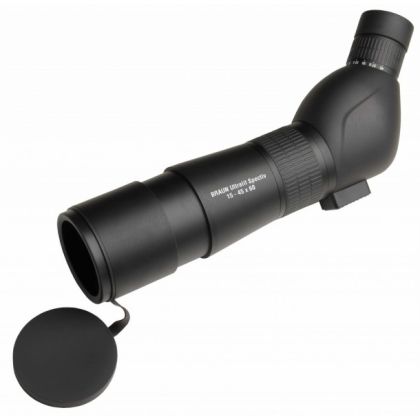
Angled scopes are the most common types of spotting scopes on the market. They have a good ergonomic design that eases your portability with the help of adjustable eyepieces for a proper aim adjustment.

They are less convenient when you need to quickly scan the surroundings, but are very versatile due to angled eyepieces. The most popular spotting scopes have a 45° angled eyepieces and some provide a 90° angle. After adjusting the focus every individual can look through without changing the aim.

Compared to straight spotting scopes that are very convenient when viewing down, angled spotting scopes perform incredibly well when looking skywards, thus saving your neck when observing the birds, mountains, the stars and the moon. Rotating eyepieces are also especially helpful when using them through a window of a vehicle. They are less suitable for youth hunters due to its heaviness and angled design but are very convenient for advanced users in hunting, surveillance, archery, astronomy and other law enforcement applications. They are more stable since you don’t have to extend the legs of a tripod too much thus providing more protection when facing wind and other harsh weather situations.

Images are also less shaky and observations for extended periods of time more comfortable. But there are still other important factors that you should take in consideration, such as the size of objective lenses, magnifications and other optical technology such as lens and prism coatings that helps you get the best view-through during long distance observations with spotting scopes.

Main Features of Angled Spotting Scope

Pros of Angled Scope

  • (+) good ergonomic design
  • (+) less shaky images
  • (+) very stable

Cons of Angled Scope

  • (-) pretty heavy
  • (-) not for quickly scanning the surroundings
  • (-) less suitable for youth hunters

Angled Spotting scope for Hunting

When it comes to hunting, hunters can use different spotting scopes depending on the type of landscape. In the flatlands and on the fields, they usually prefer straight spotting scopes because it is easier to find a target in their field of view. All they have to do is point the spotting scope in the direction of the target. 

Hunting in the mountains is a different story. In the mountains, hunter finds an animal on a mountain slope and then stalk it up the hill. That is when angled spotting scope comes into play. The advantage of the angled spotting scope is that the hunter does not need to overstretch his neck while using it.

This type of spotting scopes can be used without a tripod - the user simply puts the scope on the top of a shoulder bag. The same goes for stalking the animal downhill. It is easier to use and carry spotting scope without the tripod; the hunter leans on a backpack and use it as a tripod.

Angled spotting scope for Birdwatching

Unlike hunters, birdwatchers use tripods very often with their spotting scopes. This means that for birdwatching, angled spotting scopes are way more appropriate. They can be used with lower and thus lighter tripods. Birdwatchers usually carry a lot of equipment on their trips, so lightweight of tripods is the crucial factor. 

Birdwatching is often a group activity that involves larger groups of people participating at the same time. Angled scopes come very handy in these situations. The tripod height is adjusted to the smallest person in the group. The taller participants have to bend forward a bit, and there is no need to change the tripod height. 

Some types of spotting scopes have a small external tube (usually made of plastic) attached to the body. When looking through it, it is much easier to point the spotting scope into the exact direction towards the birds.

Angled spotting scope for Digiscoping

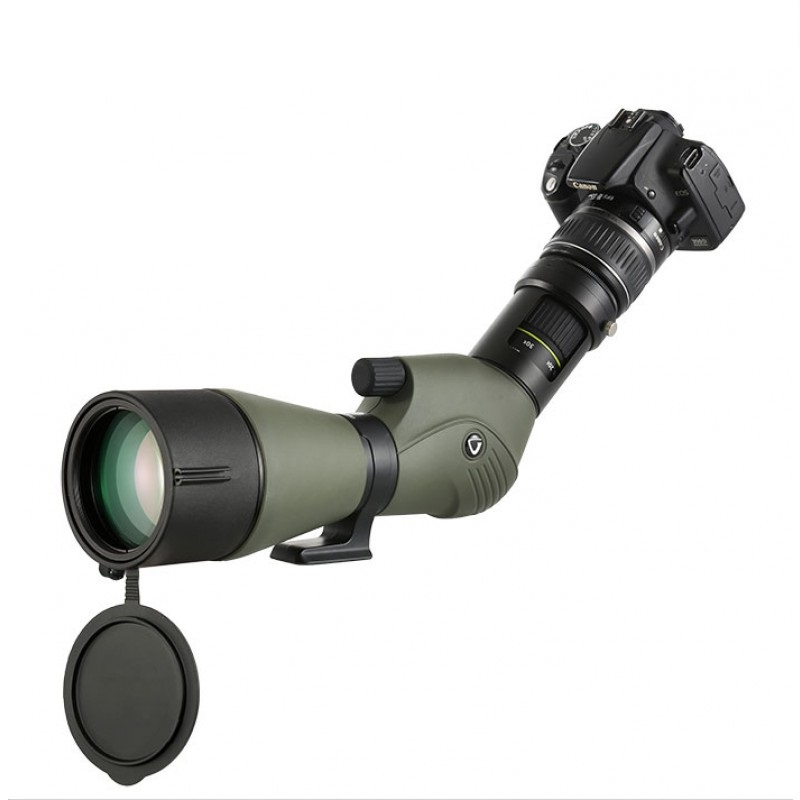
A lot of people love to take pictures of landscapes or birds they are observing. In order to do that, their phones or cameras need to connect with their spotting scopes. Most of the spotting scopes manufacturers also produce digiscoping equipment for both straight and angled types.

When it comes to the quality of the material, there is no difference between the two. The only difference is that angled scopes are more compact due to their shorter lengths. This means it is easier to support the digiscoping setup when there is an additional weight of a digital camera or a phone.

Supporting rails

For the stability of the whole digiscoping setup, a special supporting rails are used.

  • The rails for angled scopes are shorter and less bulky. Since a tripod is an essential piece of equipment for digiscoping, angled scopes are the preferred choice.

  • Low weight and small size of a tripod is very significant for digiscoping, and not so much for regular use. Only one person usually does the digiscoping activity.

  • Digiscoping requires many pieces of equipment, meaning that weight factor plays a significant role.

Angled Scope for Digiscoping

Camera installed to Angled Spotting Scope 

Focusing mechanism type on Angled Spotting Scope

Most of the angled scopes have one rotating knob for focusing. The focusing knob is located on the top of the body.

Two-piece focusing knob

Some more expensive models have a two-piece focusing knob:

  • the first part is for fast and rough settings

  • the second part is for finer adjustments and therefore focuses on lower speed.

Angled Spotting ScopeAngled Spotting Scope

Spotting Scope with one rotating knob and Spotting scope with two-piece focusing knob.

On some spotting scopes focusing is done with a unique ring that goes around the entire body. Swarovski is a prime example of this approach. These focusing rings have a bigger diameter. A more prominent knob enables finer adjustments at a constant speed.

Waterproofness of Spotting Scope

Most of the spotting scopes are waterproof and filled with either nitrogen or argon. The only weakness is the bayonet mount for interchangeable eyepiece, which is a part of the most premium spotting scopes.

More affordable spotting scopes have a fixed eyepiece, which ensures even better protection against water intrusion. Even if the scope comes with an eyepiece as a separate part, it remains waterproofed when assembled. The connection between the eyepiece and the body is well sealed. 

Both eyepiece and the angled scope body are waterproof as standalone units

  • There is no permanent damage if the water comes in the middle space.

  • The water can be dried, and there is no permanent damage.

  • The problem occurs when the eyepiece is removed and exposed to rain. This way, the water could come in the space between the body and the eyepiece.

  • The water intrusion can cause unclear images. 

The recommendation is to fix the eyepiece somewhere in a dry space and then leave it until the end of use. 

Red Dot Sights on Angled spotting scope

Many angled scopes feature one or more small Picatinny rails on the housing. The Picatinny rail has a most common use as a platform for mounting a red dot sight on the spotting scope.

A lot of hunters and long-range shooters use this setup for rapid target acquisition with their spotting scopes. First, they zero the red dot sight in the center on the field of view. Then they use the red dot sight to point the spotting scope precisely on the observation object.

Red dots are used for different purposes: 

  • The first example is a shooting competition. Since identical targets are lined up in a row, it is hard to determine which one belongs to each contestant. With the red dot installed to a scope, the shooter can quickly point to the correct target and ensure he is looking at the right one.

  • The next example is hunting in the mountains. When the guide wants to show the hunter a specific animal in the herd, he can very quickly locate it with the angled spotting scope and red dot installed on to it.

  • The last example is birdwatching. A group of people wants to see a specific bird in the flock of birds. One person finds the bird with the help of a scope and a red dot. The other participants can look through the scope and see it.

A short presentation is available here. 

 Slideshare Presentation of Angled Spotting Scope