Close

Merkel SR 1 Basic

About the Merkel

Affected by the industrial revolution, the beginnings of the Merkel Jagd- und Sportwaffen GmbH began in 1898 when three brothers Albert Oskar, Gebhard and Karl Paul Merkel created a company under the name Gebrüder Merkel. They started manufacturing firearms in 1905 as a relatively small firm and remained like that during the war as the total number of employees hardly ever exceeded 350. Mainly focusing on export, the company even lost some of its foreign markets, hence pushing the innovativeness in the forefront of their marketing strategy which is to this day notable in their workshop diaries from the time. As the hunting rifles production suffered during the war, they struggled for many years after it ended. However, in the following years, their aesthetically built hunting rifles were again gradually beginning to be sought after in 28 foreign countries. In 1924, one of the most unique and recognizable models – Merkel 303 was presented.

Two years after registering a trademark and gaining rights to the use of the term 'Bock' (over-and-under), Gebhard Merkel passed away in 1933, missing a chance of witnessing the ‘Grand Prix’ prize being awarded to the company in 1937 which increased the export business significantly. In the following year, the management was handed over to Adolf Schade and Ernst Merkel. Their rifles were mostly sold to the upper class - diplomats, famous hunters and industrialists became fond of the company's meticulousness and consistent quality which further broadened Merkel's reputation.

During the Second World War, the market network, consisting of many foreign countries, shrivelled little by little. The war industry was once again preventing the company to focus on what they had been known to do best, subordinating the production of hunting rifles to military weapons manufacturing. At this point, they started adjusting their production accordingly to the market demand, supplying other companies with what the industry needed the most - from carburettor to carbine and rangefinder parts.

Despite the war physically destroying or dismantling a large portion of German factories, Merkel was able to escape such fate, most likely due to its good reputation. At the end of 1945, they restarted the production of hunting rifles, however, due to the Soviet occupation, Merkel successors lost all rights to the company which now operated under the new state of the German Democratic Republic. The Soviets familiarized the company with the two most powerful and influential men at that time - Dwight D. Eisenhower and Nikita S. Chruschtschow which resulted in the first man in space – Juri Gagarin – to be given a Merkel Drilling. Consequently, the socialist regime exploited the company’s notoriety, focusing again on supplying the richest and most prominent people such as Josip Broz Tito, Gamal Abdel Nasser and even Mao Tse Tung. Up until 1987, the production of over-and-under rifles reached 150.000 pieces and the company additionally had a breakthrough in the sport shooting market.

After the fall of the Berlin Wall in 1989, they struggled with outdated technology, however, foreign investors helped significantly with the expansion of the company which resulted in the development of some of the new products such as HELIX, SR1, K5 and SxS series. Up to this day, the company preserved the tradition of the high-quality, handcrafted character of their rifles combined with a vibrant history that laid the foundation for one of the greatest firearm companies of the 21st century.

Merkel SR1 (Basic) Rifle Review

Merkel SR1 is a push feed semiautomatic rifle with a self-loading gas pressure system and intelligent release which prevents the charging handle to spring forwards when feeding the cartridge for the first time. The rifle features Duraluminium housing with a solid rotary bolt head that locks the six locking lugs into the barrel for extra safety.

There are some minor differences between SR1 Basic and SR1 Standard models. The SR1 Standard comes with options of changing stock dimensions and light dismantling which are not available on SR1 Basic. The wood class is different too – SR1 Basic is only available in wood class 1. Although redesigned, SR1 Basic shares the same mounting surface with the Heckler & Koch 2000 and 2000+ models since H&K company sold their original designs of those rifles to the Merkel once they ended their production. SR1 Basic and SR1 Standard, however, do not share the same mounting surface. Basic variant features five holes for mounting purposes and has a longer B distance, whereas SR1 Standard only has four mounting holes and a shorter B distance. Unfortunately, this might cause some confusion among the users as one would expect interchangeability not to be an issue within what is essentially the same rifle series.

A fast-rolling shutter and a free-floating barrel made of high strength steel allow for swift, minimal effort shooting. The detachable magazine can hold 2 or 5 rounds. The safety catch that is activated by pushing it to the right is positioned at the rear of the trigger guard and is easily reachable.

Merkel SR1 Basic is available in standard or magnum calibres.

Possible barrel lengths for Merkel SR1 are 500 mm (19.7 -inch) and 510 mm (20-inch).

Merkel SR1 Basic

Figure 1: Merkel SR1 asic, chambered for 9,3x62mm (Source: https://www.progun.de/marketplace/~schutzwesten_und_tracker/3qg2zvs7_merkel_merkel_selbstladebuechse_sr1_basic_suppressor_cal93x62.html)

Merkel SR1 Basic can be chambered for the following calibres:

  • .223 Rem.

  • .270 Win.

  • 7x64

  • .308 Win.

  • .30-06 Spr.

  • .300 Win. Mag.

  • 8x57 JS

  • 9.3x62

Calibre choice depends on the variant.

SR1 rifles are available in the following variants:

  • SR1 Basic
  • SR1 Basic Suppressor

All Merkel SR1 Basic receivers come with five holes for mounting purposes, two on the front and three on the rear of the receiver. 

Merkel SR1 Basic

Figure 2: The receiver of Merkel SR1 Basic, chambered for .30-06 Spr. (Source: https://www.youtube.com/watch?v=DJHR7H0dRC4)

A: 21.9 mm

B: 98.5 mm

C: 2x15.4 mm

BHU: 0 mm

Ø: 6-48

R1: 17.3

R2: 17.3

Which Rifles have interchangeable Mounts

Two-piece mounts

For two-piece mounts to fit on a rifle, mounting surfaces must match in all dimensions except the B distance. B distance can vary because two-piece mounts can be installed and adjusted closer or further apart. Rifles that meet such criteria and have interchangeable two-piece mounts with Merkel SR1 Basic are:

  • Heckler & Koch SLB 2000
  • Heckler & Koch SLB 2000 +
  • Heckler & Koch SLB 2000 Light

One-piece mounts

All Merkel SR1 Basic receivers come with five holes for mounting purposes, two on the front and three on the rear mounting surface. For one-piece mounts to fit on a rifle, mounting surfaces on these rifles must match in every dimension. Rifles listed in the category below have interchangeable one-piece mounts with the SR1 Basic variant.

  • Heckler & Koch SLB 2000
  • Heckler & Koch SLB 2000 +
  • Heckler & Koch SLB 2000 Light

Our Recommendations for Mounts

Fixed Mounts

These steel made MAKfix rings with bases match all necessary receiver dimensions of H&K SLB 2000 and Merkel SR1 Basic and are, therefore, interchangeable between the mentioned rifles. They present a functional and reliable solution for your Merkel SR1 Basic.

Detachable Repeatable Mounts

This repeatable two-piece pivot mounting solution made by the German company Recknagel is quick and easy to install and take off whenever you want to use a different scope. It is made of steel and comes with a 30-year warranty.

Picatinny Rails

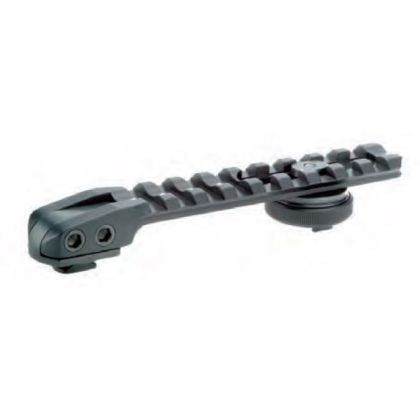
When purchasing a Picatinny rail, the receiver dimensions should always match the ones on the rail itself. This ERA-TAC Picatinny mounting solution is manufactured in Germany, made of light aluminium, and comes with included screws.

Help us build our riflescope mounts database

If you happen to own this or any other rifle, we would appreciate it if you could help us expand our database by sending us some photos of the rifle receiver (the bare mounting surface of the rifle without the mounts installed). For your help, our company offers a fair return in terms of practical rewards. 

Please send us an email for more information. You can contact us here: [email protected]

Filters
Sort
18 Items
Show
per page
Close
Sort By
  1. In stock
  2. Out of stock
  1. Cheapest in stock
In stock
CHF 66.88
In stock
CHF 66.88
In stock
CHF 66.88
In stock
CHF 66.88
In stock
CHF 59.55
In stock
CHF 82.46
In stock
As low as CHF 292.26
In stock
CHF 114.52
In stock
CHF 82.46
In stock
CHF 82.46
In stock
CHF 52.22
In stock
CHF 75.13
In stock
CHF 75.13
In stock
CHF 52.22
In stock
CHF 82.46
In stock
CHF 127.35
In stock
CHF 82.46
In stock
CHF 82.46
Filters
Sort
18 Items
Show
per page
Close
Sort By

VIDEO

Introduction

In recent years we can observe that a trend of Picatinny rail has become widespread and global. It is driven by the NATO standardized rails, more commonly known as the Picatinny rail standard. Picatinny rail being the New Jersey Arsenal that developed it in 1995.

These mounting options are revolutionary. The biggest and best advantage being that the Picatinny rail can be used its entire length and not bordered to a few pre-designed slots like for example the Weaver rail standard was before.

The other main advantage is the ease of use and interchangeability. If a product is meant for a Picatinny rail design it will fit all Picatinny-rails, no matter the manufacturer or date of production.

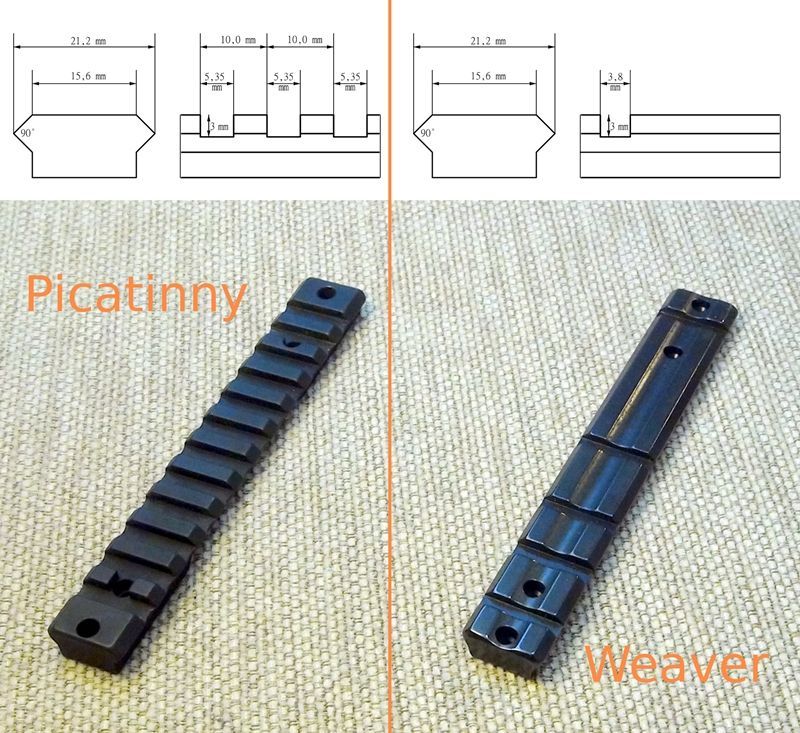
Picatinny/Weaver Rail

Picatinny Rail and Weaver rail profile

Design

The Picatinny rail is almost exclusively crafted from a single piece of metal (in some cases aluminum). In this manner, the axis of the Picatinny rail is perfectly straight and aligned with the axis of the firearm. Therefore the rifle scope which is mounted onto this kind of configuration is certainly aligned with the rifle / gun and the trajectory of the ammunition.

Weaver rail design on the other hand is usually manufactured in two separate pieces, greatly increasing the possibilities for the axis to be crooked, overlapping, and out of line.

It is always harder to align two separate pieces to a third line than it is to align one piece to another. In this way, the lapping of two mounting rings on a single-piece Picatinny rail is no longer required.

The single-piece rail will assure that both rings are perfectly aligned to each other and that no unwished stress is transferred to the riflescope.  

Picatinny compare to Weaver Rail

The Picatinny rail itself is an evolutionary step forward from the older Weaver rail. The main difference between Picatinny rail and Weaver rail is the spacing of the slots. Picatinny rail design has them evenly placed exactly 5.23 mm from one slot to the other, 3 mm deep. For this reason, the mounting options are repeatable and the same as other firearms using the Picatinny rail standard.

Interchangeability was a major driving force in the development of the new standard as different NATO armies need to be compatible with each other.

Weaver rail has 3.8mm wide slots and these slots can be placed anywhere on the Weaver rail and in any number that the producer wished.

Advantages of Picatinny design

A big advantage for using the Picatinny rail design is the ever-present recoil stop. Furthermore, the manufacturing of the rail is not very technically demanding and can be done without the use of state-of-the-art machines which greatly reduces the cost of the finished product, making it very affordable.

The Picatinny rail is easy to mount and usually, this type of configuration does not transfer negative stresses and forces from the fired weapon to the rifle scope.

In addition, the Picatinny rail with its very long useable surface works well for mounting longer rifle scopes or to achieve optimum eye relief.

The durability and toughness are other big pluses for this solution.

Manufacturers of Popular Models

A majority of the Picatinny rings are fixed, but a number of best rated European manufacturers (EAW, MAK,..) have, in recent years, put a lot of effort into the development of detachable ring with100% repeatability, with which it becomes easy to remove the scope from the weapon without the use of tools.

No re-zeroing is needed with such mount options, but these models tend to be expensive. 

Weaver and Picatinny Rings

Picatinny rail and weaver rail share one more thing. It is possible to use the Weaver ring and the Picatinny ring on the Picatinny-rails, but it is usually impossible to use the Picatinny ring on the Weaver base. The reason being the above-mentioned positioning and spacing of the slots.

  • Picatinny mounts have a 5mm recoil stop that goes into the rail slot and since
  • Weaver rail only has 3.8mm wide slots such rings do not fit on Weaver rails.

Due to this reason, the Picatinny-rails are popular and prevailing on the market in recent years and eventually, these options will completely oust the Weaver rail from the market.