
In 2025, Pulsar introduced the thermal monocular Oryx LRF XG35. The name Oryx is used for the first time within Pulsar’s product lineup, suggesting that the company wanted to signal something entirely new… Something different from all previous Pulsar devices.
We must admit that the Oryx also looks noticeably different from the Axion series, attracting attention and curiosity regarding potential innovations. During last autumn’s field test in the hunting grounds, we had plenty of opportunities to use the device in various conditions and form an opinion on how much of the Oryx is actually new and how much consists merely of cosmetic exterior changes.

Pulsar Oryx LRF XG35 – Full Technical Specifications
| Sensor | VOx Uncooled 640×480 12 µmSensor NETD <40 mKSystem NETD <20 mK |
| Lens | 35mm / F 1.0 |
| Magnification | 2,5 x basic magnification(2x,4x,8x digital zoom) |
| Field of view | 22m x 12m/100m |
| Detection range | 1800 m |
| Laser rangefinder | Class 1 / 905 nm |
| Max range | 1500 m |
| Accuracy | ± 1 m |
| Display | AMOLED HD, 1024×768 |
| Power supply | 1x internal Li-ion battery 3200mAh1x APS5 Li-ion external battery 4900mAhtime ≥12h (according to manufacturer)USB – C |
| Dimensions | L179mm X V52mm X H77mm, 500g with battery |
| Protection | IPX7 |
| Video/photo recording | Resolution: 1024x768Format: mp4 / .jpg64GB internal memory |
From a technical perspective, the Oryx does not introduce any significant changes. It follows a well-established concept of a thermal monocular with a medium-sized 640×480 sensor, 12 μm pixel pitch, a 35 mm lens, and roughly a 22 m wide field of view at the base 2.5× magnification.
Much more effort was put into the exterior and ergonomics than into internal components.

Pulsar Oryx LRF XG35 Field Test and Performance Review
How Good Is the Image Quality on the Oryx LRF XG35?
Based on our experience, Pulsar’s main goal with the Oryx LRF XG35 seems to have been to improve ergonomics and the user interface rather than image quality. We should note that the image itself is perfectly fine; however, it does not represent a revolutionary improvement compared to Pulsar’s Axion 2 models with XG sensors and 35 mm lenses.
The image is characteristically “Pulsar-like” and somewhat different from Chinese competitors. In good weather, the contrast between observed objects and the background is not extraordinary. When used side-by-side with a Chinese device of comparable specifications, we consistently felt that the Oryx produced a less contrast-rich image, though one that was easier on the eyes. During extended use, the Oryx image was less tiring.
In good conditions, despite having similar nominal detection ranges, the Chinese monocular detected animals at extreme distances more effectively. For example, we missed a hare hidden in the grass at roughly 500 m with the Oryx, but spotted it with the Chinese device first. Once we knew where to look, the Oryx detected it too, but we still had the impression that scanning with the Chinese device was faster and more precise in good conditions.
The relationship changed completely in poor thermal conditions. In fog, both devices experienced reduced detection range, but significantly less so with the Oryx.
Taking into account image quality in good conditions (better with the Chinese device) versus poor conditions (better with the Oryx), the Oryx comes out ahead overall.
The image quality allowed us to distinguish wild boar gender at typical night-hunting distances. We could also identify roe buck antlers at up to ~100 m. In good weather, the surroundings were rendered clearly enough for orientation; in fog or rain, the surroundings appeared washed out, which is typical for all thermal devices.
Unlike previous Pulsar devices we tested, the Oryx performed best with signal amplification set to the second of three levels. The highest level was useful only in truly poor conditions, where we also increased contrast to 15/20.
The image can be displayed in nine palettes (white hot, black hot, green, red hot, red monochrome, rainbow, ultramarine, violet, sepia). Besides standard white/black hot, we used the green palette extensively. Warm objects appear white, while the background is greenish, reducing eye fatigue and preserving night vision.
Selecting a palette requires entering the main menu, which is one of the things Pulsar could improve. A long press on the signal-boost button toggles between the selected palette and white hot.
Digital zoom steps: 2×, 4×, 8× (or 0.1× increments via quick menu).
2× and 4× zoom preserve useful detail; 8× is heavily pixelated but can still be useful at short distances.
Calibration was more frequent initially but not disruptive; once warm, the unit calibrated only occasionally.

Design, Ergonomics and User-Friendly Features
From an ergonomic perspective, the Oryx represents a major leap forward compared to Axion and Telos. By integrating a small LRF module under the objective lens, Pulsar made the device significantly more compact than the Axion 2 XG35 LRF. Nothing protrudes from the housing, eliminating snag risks.
Combined with a thin, narrow, slightly taller body, the Oryx is among the most compact 640×480/35 mm/LRF/replaceable-battery monoculars on the market.
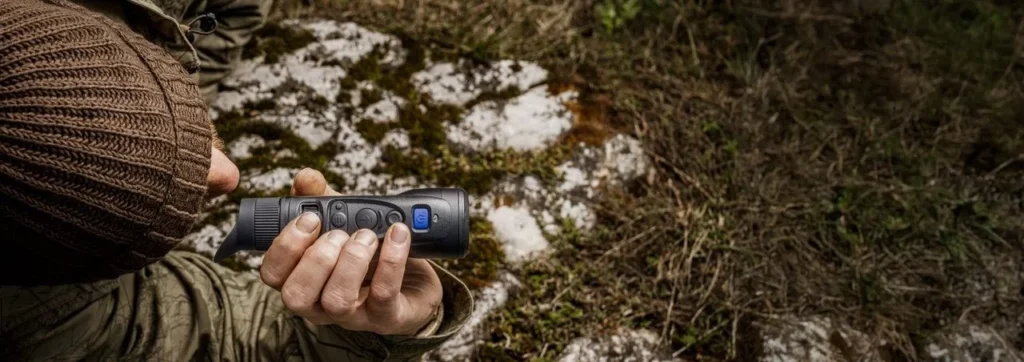
A key novelty is the focus wheel placed near the eyepiece, just ahead of the menu buttons. This supports true one-handed operation, leaving the other hand free for rifle handling. ThermTec introduced this concept first; nearly all manufacturers followed soon after.
During testing, we attempted as much one-handed operation as possible. It worked best when simply observing with the monocular in the right hand. Using it left-handed while holding a rifle in the right hand was more challenging, especially when trying to use all six buttons plus the focus wheel. We ultimately limited one-handed use to essential functions: focusing, LRF activation, and recording.
The three small menu buttons are arranged in a compact triangle rather than a row. The centre button opens the quick and main menu and confirms selections; the left and right buttons navigate. This layout allows menu operation with a single finger. Once we adapted, the operation became intuitive—with bare fingers. With gloves, the buttons were too small to feel reliably.
Behind the menu buttons are the LRF button and the photo/video button—large enough for gloved use but far enough apart that one often has to reposition the hand or use the middle finger. The rear-most button powers the device on/off; its placement made accidental presses possible.
A light sensor near the power button adjusts screen and button brightness based on ambient light. It can be disabled, after which brightness must be set manually.
Oryx also introduces haptic feedback: a vibration upon button press confirming input. While potentially useful with gloves, we found constant vibration distracting and quickly disabled it.
Digital image stabilization proved useful even at base magnification when our hands shook in cold weather. It stabilizes slow observation but causes lag and choppy motion during fast scanning, sometimes causing nausea. Thus, we used it selectively.
The monocular includes a screen-off tilt sensor that turns off the display when hanging from the neck or placed sideways, saving battery and preventing unwanted face illumination. However, when observing straight down from a high stand, the sensor sometimes misinterpreted orientation and turned the screen off.
The Oryx is fully ambidextrous. The hand strap can be mounted on either side, and the objective lens cap attaches magnetically to it. A clip on the opposite side allows attaching the device to clothing or a rifle sling, preventing it from swinging while walking.
Stream Vision 2 app functionality was stable and reliable even in crowded Wi-Fi environments. It allows transferring photos/videos, remote operation of most functions, and firmware updates. Files can also be transferred via USB, with the device recognized as external storage.
Battery Life and Power Options on the Oryx XG35
The Oryx LRF XG35 uses two batteries. Internal one with 3200 mAh and external, replaceable APS5 with 4900 mAh.
Combined operating time is quoted at 12 hours, though real-world runtime depends on temperature and frequency of LRF use.
How Good Is the Built-In Laser Rangefinder?
The LRF measures up to 1500 m—an improvement over older Pulsar models limited to 1000 m.
During testing, increased laser power appeared beneficial in poor conditions (humidity, fog), providing more reliable readings than older models, though no device performs miracles in dense fog.
Units can be set to meters or yards.
Oryx XG35 Turns into a Ballistic Calculator With Stream Vision Ballistics
When connected to Stream Vision Ballistics, the Oryx can function as a ballistic calculator. If ammunition data is entered correctly, the app calculates bullet drop for the distances measured by the LRF.
When paired via Bluetooth with a Pulsar thermal riflescope, ballistic corrections are automatically transmitted to the scope, adjusting the reticle to compensate for bullet drop.
We were unable to test this functionality in practice and base our comments on the manufacturer’s description.
What’s Included in the Oryx LRF XG35 Package?
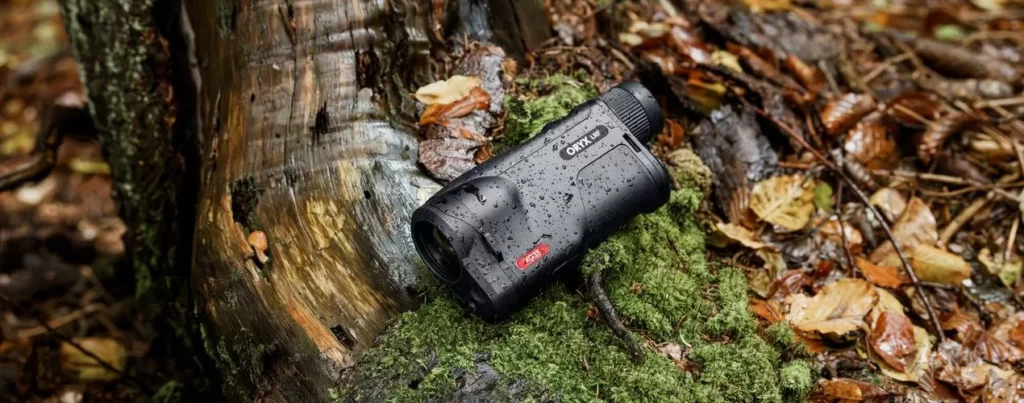
Included in the box are the Oryx thermal monocular, 1× APS5 battery, USB-C cable with charger for internal/external batteries, neck strap, carrying case, mounting clip, lens cleaning cloth, and quick-start guide.
Final Verdict: Is the Pulsar Oryx LRF XG35 Worth It?
The Oryx XG35 LRF is Pulsar’s newest thermal monocular at the time of testing. With Axion 2 LRF now discontinued, the Oryx is currently Pulsar’s most compact monocular with a built-in laser rangefinder.
It offers a noticeable image-quality upgrade for users of Pulsar Axion models with XQ sensors, and a significant ergonomic and compactness improvement over Axion XG LRF devices. With one-handed operation, Pulsar follows the industry trend initiated by ThermTec’s Wild series in 2024.
With a 35 mm lens, 640×480 sensor, 12 μm pixel pitch, and a 22-meter-wide field of view, the Oryx is a versatile monocular, well-suited for short-range forest stalking, bait-site hunting, and capable of identifying game species at longer distances, though not competing with 50 mm lens devices.
A major advantage is Pulsar’s updated pricing strategy: the Oryx LRF XG35 is priced competitively with Chinese alternatives, while offering premium build quality and fully European manufacturing.

