Close

Zastava M93 Black Arrow

The History of Zastava

The beginnings of Zastava Arms reach back to 1853 when the company presented four cannons and two howitzers in their facilities in Kragujevac, Serbia. The factory was initially named Vojno-Tehnicki Zavod (Military Technical Institute) but was renamed at the end of the 19th century to Military Engineering Works. In 1904 the segment of the company dedicated to the automobile industry was opened which was renamed Zavodi Crvena Zastava ("Red Flag Factories") after World War II.

The arms production facilities were upgraded significantly in the 1860s and in 1880, the first repeating rifle inspired by the Mauser Model 1871 was presented by Kosta Milanovič. The rifle was also known under the name ‘Mauser Koka’. After a signed contract with FN Herstal in 1925, the company gained rights to produce the M24 series bolt-action rifles under their license. In 1928, Zastava started the production of rifles and ammunition in their new factory that was built only a few years prior. Due to enlarged facilities, they started manufacturing the Czechoslovakian 26 mm M 1929 signal pistols and light ZB vz. 26 machine guns under the Zbrojovka Brno license.

During World War II, Zastava facilities were severely damaged but were repaired in 1944 when the city of Kragujevac was liberated. Due to the ongoing war, the factory was repaired in the same year and the production of the 9mm M 1944 B2 submachine gun was launched.

After the War, Zastava M48 was introduced. The structural design of the M48 was based on the Belgian Mauser M24 series – a line of German Mauser Gewehr 98. The production of shotguns and small-bore rifles was launched in 1954 together with the M53 machine gun that evolved from the German MG 42. The derivatives of Soviet weapons can be traced back to Zastava as well. One such example is the PAP M59/66 semi-automatic rifle presented in 1961 which was manufactured as the licensed version of the Soviet SKS. 

The M67 model which had been introduced in the following years set the foundations for the development of the Zastava M70 presented in 1970, which was later adopted by the Yugoslavian army. In the 1970s, a heavy machine gun was released which was design-wise much like the NSV machine gun. It was named Zastava M02 Coyote and it could fire over 700 rounds per minute. After a new plant had opened in the 80s, Zastava introduced several new models such as the M88 compact pistol, CZ99 pistol, M84, M86 and M92 machine guns etc.

Although the production was significantly slowed because of the UN sanctions during the Yugoslav wars, Zastava continued its production and signed an agreement with Remington Arms in 2005 which allowed for the export of hunting and sporting rifles to the United States. Consequently, the company was reconstructed in the following years. Despite the escalating debts, their facilities were modernized in 2017. In 2019, the company announced the opening of the Zastava Arms USA branch for import and distribution purposes, with the production of firearms significantly increasing in 2020.

Zastava M93 Black Arrow Rifle Review

Zastava company first introduced the M93 Black Arrow model in 1998; however, the initial design of the model was presented in 1993. This bolt action, controlled feed precision rifle is still manufactured today with the increasing number of riffles being exported to the US market. It has an effective range of 1800 meters for non-combat vehicles and 800 meters for armored combat vehicles. The M93 Black Arrow is a mixture of scaled-up components used on various other rifles. The enlarged action is based on Mauser 98 – the bolt with two main locking lugs and an additional one on the rear end, the bolt release lever, and the sliding grooves inside of the receiver can all be traced back to the 98-action.

Zastava did not only borrow Mauser’s design, but they also implemented structural components used on the French sniper rifle MAS FR F1. Such are the Magazine release lever on the front right end of the action, trigger safety mechanism, firing pin, and front and rear sights which are foldable but cannot be adjusted. One could almost not tell these components apart were it not for their size difference (the M93 is significantly bigger compared to the FR F1).

The stock of the Black Arrow is made from a quality polymer material which is reinforced with glass fibers. The 838mm (33-inch) long heavy barrel is cold forged and suitable for .50 Browning or 12.7×108mm calibers. The two-position safety notch is positioned behind the single trigger which is not adjustable. In the vertical position the trigger is locked in place and cannot be pulled back, and when switched to the left in the horizontal position, the safety is unlocked, and the rifle is ready to fire. The removable box magazine can hold up to five rounds. Additionally, the rifle comes with a height-adjustable bipod, an integrated carry handle and a two-chamber muzzle brake on the front of the barrel.

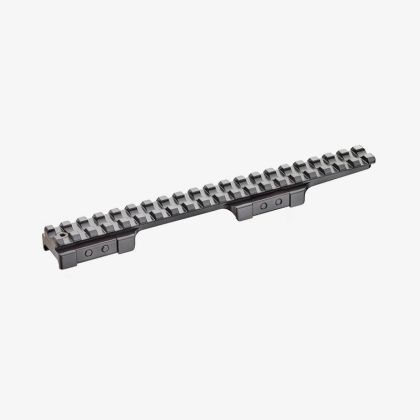
Newer versions of the M93 use a large Picatinny rail that is screwed up on the top of the receiver for scope mounting purposes whereas the older versions of the rifle featured an FR F1-inspired quick detach dovetail mounting system.

The M93 Black Arrow comes with 838mm (33-inch) long barrel.

Zastava M93 Black Arrow

Figure 1: Zastava M93 Black Arrow, chambered for .50 BMG caliber (Source: https://atlanticfirearms.com/zastava-arms-m93-rifle-50-bmg#)

Zastava M93 Black Arrow Calibers

The rifle is available in the following calibers:

  • .50 BMG

  • 12.7×108mm 

The newer version of the M93 uses a large Picatinny rail that is screwed up on the top of the receiver for scope mounting purposes.

The receiver of Zastava M93 Black Arrow

Figure 2: The receiver of Zastava M93 Black Arrow, chambered for .50 BMG (Source: https://atlanticfirearms.com/zastava-arms-m93-rifle-50-bmg#)

Should you happen to own an older version of the Zastava M93 Black Arrow with a quick detach dovetail mounting surface, we would appreciate it if you could send us some photos of the bare mounting surface (no mounts installed). If you are looking for a scope mount, suitable for the early dovetail generation, we kindly ask you to contact us at i[email protected] where our team of experts will be happy to assist you with finding a suitable mounting solution for your rifle.

Scope Mounts Interchangeable With Zastava M93 Black Arrow
Rifles That Have One-Piece Scope Mounts Interchangeable With Zastava M93 Black Arrow

All the rifles listed in the category below have one-piece scope mounts interchangeable with Zastava M93 Black Arrow. Rifles that have the same mounting surface as Zastava M93 Black Arrow are:

  • Rifles featuring a Picatinny rail for mounting purposes

Rifles That Have Two-Piece Scope Mounts Interchangeable With Zastava M93 Black Arrow

All the rifles listed in the category below have two-piece scope mounts interchangeable with Zastava M93 Black Arrow:

  • Rifles featuring a Picatinny rail for mounting purposes

Best Scope Mounts for Zastava M93 Black Arrow

Fixed Scope Mounts for Zastava M93 Black Arrow

If you are looking for a fixed mounting solution to install on your Zastava M93 Black Arrow, we recommend this mono-block mount for Picatinny manufactured by the Swedish company Spuhr. It is made of high-quality aluminum and comes with a two-year warranty.

Detachable Repeatable Scope Mounts for Zastava M93 Black Arrow

We recommend this mono-block mounting solution manufactured by the Swedish company Spuhr that provides the user with the flexibility of easily attaching and detaching an optic without any tools and retaining zero at the same time.

Help Us Build Our Riflescope Mounts Database

If you happen to own this or any other rifle, we would appreciate it if you could help us expand our database by sending us some photos of the rifle receiver (the bare mounting surface of the rifle without the scope mounts installed). For your help, our company offers a fair return in terms of practical rewards.

Please send us an email for more information. You can contact us here: [email protected]

Filters
Sort
22 Items
Show
per page
Close
Sort By
  1. In stock
  2. Out of stock
  1. Cheapest in stock
In stock
NOK 1,034.18
In stock
NOK 2,928.37
In stock
As low as NOK 1,513.17
In stock
As low as NOK 1,034.18
In stock
NOK 228.61
In stock
As low as NOK 1,687.35
In stock
NOK 1,905.08
In stock
NOK 2,928.37
In stock
NOK 228.61
In stock
NOK 446.33
In stock
As low as NOK 2,928.37
In stock
As low as NOK 2,340.52
In stock
As low as NOK 3,254.96
In stock
As low as NOK 1,469.63
In stock
As low as NOK 1,251.91
In stock
As low as NOK 1,948.62
In stock
NOK 1,513.17
In stock
NOK 1,513.17
In stock
NOK 446.33
In stock
NOK 827.35
In stock
NOK 1,687.35
In stock
NOK 1,687.35
Filters
Sort
22 Items
Show
per page
Close
Sort By

VIDEO

Introduction

In recent years we can observe that a trend of Picatinny rail has become widespread and global. It is driven by the NATO standardized rails, more commonly known as the Picatinny rail standard. Picatinny rail being the New Jersey Arsenal that developed it in 1995.

These mounting options are revolutionary. The biggest and best advantage being that the Picatinny rail can be used its entire length and not bordered to a few pre-designed slots like for example the Weaver rail standard was before.

The other main advantage is the ease of use and interchangeability. If a product is meant for a Picatinny rail design it will fit all Picatinny-rails, no matter the manufacturer or date of production.

Picatinny/Weaver Rail

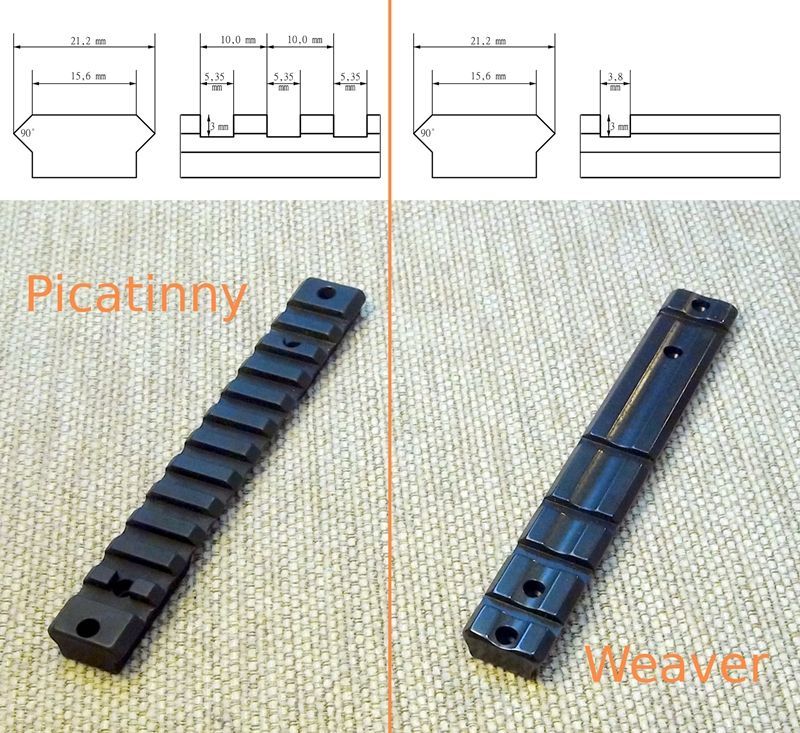
Picatinny Rail and Weaver rail profile

Design

The Picatinny rail is almost exclusively crafted from a single piece of metal (in some cases aluminum). In this manner, the axis of the Picatinny rail is perfectly straight and aligned with the axis of the firearm. Therefore the rifle scope which is mounted onto this kind of configuration is certainly aligned with the rifle / gun and the trajectory of the ammunition.

Weaver rail design on the other hand is usually manufactured in two separate pieces, greatly increasing the possibilities for the axis to be crooked, overlapping, and out of line.

It is always harder to align two separate pieces to a third line than it is to align one piece to another. In this way, the lapping of two mounting rings on a single-piece Picatinny rail is no longer required.

The single-piece rail will assure that both rings are perfectly aligned to each other and that no unwished stress is transferred to the riflescope.  

Picatinny compare to Weaver Rail

The Picatinny rail itself is an evolutionary step forward from the older Weaver rail. The main difference between Picatinny rail and Weaver rail is the spacing of the slots. Picatinny rail design has them evenly placed exactly 5.23 mm from one slot to the other, 3 mm deep. For this reason, the mounting options are repeatable and the same as other firearms using the Picatinny rail standard.

Interchangeability was a major driving force in the development of the new standard as different NATO armies need to be compatible with each other.

Weaver rail has 3.8mm wide slots and these slots can be placed anywhere on the Weaver rail and in any number that the producer wished.

Advantages of Picatinny design

A big advantage for using the Picatinny rail design is the ever-present recoil stop. Furthermore, the manufacturing of the rail is not very technically demanding and can be done without the use of state-of-the-art machines which greatly reduces the cost of the finished product, making it very affordable.

The Picatinny rail is easy to mount and usually, this type of configuration does not transfer negative stresses and forces from the fired weapon to the rifle scope.

In addition, the Picatinny rail with its very long useable surface works well for mounting longer rifle scopes or to achieve optimum eye relief.

The durability and toughness are other big pluses for this solution.

Manufacturers of Popular Models

A majority of the Picatinny rings are fixed, but a number of best rated European manufacturers (EAW, MAK,..) have, in recent years, put a lot of effort into the development of detachable ring with100% repeatability, with which it becomes easy to remove the scope from the weapon without the use of tools.

No re-zeroing is needed with such mount options, but these models tend to be expensive. 

Weaver and Picatinny Rings

Picatinny rail and weaver rail share one more thing. It is possible to use the Weaver ring and the Picatinny ring on the Picatinny-rails, but it is usually impossible to use the Picatinny ring on the Weaver base. The reason being the above-mentioned positioning and spacing of the slots.

  • Picatinny mounts have a 5mm recoil stop that goes into the rail slot and since
  • Weaver rail only has 3.8mm wide slots such rings do not fit on Weaver rails.

Due to this reason, the Picatinny-rails are popular and prevailing on the market in recent years and eventually, these options will completely oust the Weaver rail from the market.