Close

Steyr M 72 L

The History of Steyr

The story of Steyr Mannlicher began in 1821 when Leopold Werndl, a blacksmith, started manufacturing iron parts for firearms in the city of Steyr. His son Josef Werndl took over his business and founded the 'Josef und Franz Werndl & Comp. Waffenfabrik und Sägemühle in Oberletten ' in 1864. In the following years, he played a crucial role in the development of several rifles, including the straight pull-rifles M. 85 and M. 86. At the beginning of the 20th century, the engineers Ferdinand Mannlicher and Otto Schönauer developed the Original Mannlicher Schönauer, a legendary hunting rifle, the production of which took place until 1973. The company grew over the years and reached a production capability of 4.000 firearms per day before World War I. After the War, Steyr was prohibited from firearm manufacturing after the Treaty of Saint-Germain-en-Laye was signed. To avoid going bankrupt, they used their knowledge and machinery to manufacture cars, bicycles, motorcycles, tractors, trucks, dynamos, electric motors, and other things (they were not allowed to resume firearm production until 1930). In 1926, the company’s name was changed to Steyr-Werke AG. It merged with Austro-Daimler-Puchwerke AG in 1934 to form Steyr-Daimler-Puch AG. Both Austro-Daimler (previously a subsidiary of Daimler-Motoren-Gesellschaft) and Puch (founded by the Slovenian inventor and mechanic Janez Puh) were active in the automobile industry, with Puch also manufacturing bicycles, motorcycles, and mopeds.

They even employed Ferdinand Porsche for a time – he made several contributions to the company – one of them was designing an air-cooled 3.5 L V8 engine for the Steyr RSO Raupenschlepper Ost tracked vehicle. Steyr is known for modifying Fiat cars and adding their engines to some of the models (Steyr-Fiat 1100 Mod E and Fiat 1400, for example). In 1972, they cooperated with Mercedes in the design of Puch G, also known as Mercedes Benz G-class.

During World War II, the company focused on firearm, vehicle, aviation engine, and ball-bearing production for the German military. After a short firearm manufacturing ban after the end of the War, Steyr resumed the production of arms in 1950. In the years that followed, they presented many innovative firearms such as StG 77 (also known as Steyr AUG), an assault rifle with a bullpup design; SSG 69, which was ahead of its time after its release in 1969, and many others. In 1989, Steyr-Daimler-Puch AG broke up into different sectors; Steyr Mannlicher AG became independent. The company has strived to be internationally oriented, so it changed its name to Steyr Arms in 2019.

Steyr Mannlicher M72 L (Leicht) Rifle Review

In 1972, Steyr presented the renewed model of the Steyr Mannlicher—Schönauer and named it M72. It comes in three different action lengths – M72 L, M72 M, and M72 S. 

There is a slight naming ambiguity regarding the Steyr M72 series. The usual L, M and S acronyms of various rifle models worldwide most often refer to either the action length or a caliber group for which a certain rifle is chambered. The abbreviations are usually used as follows:

L – Long

M – Medium

S – Small

However, the acronyms used by Steyr are adapted to a German language and refer to the caliber groups; therefore, they have a different meaning:

L – Leicht (light)

M – Medium (same as in English)

S – Schwer (heavy)

With a length of just over 100 mm, the M72 L has the shortest action among the three.

The rifle is of a controlled feed bolt-action type, manufactured up until 1976. It utilizes a modern front locking action with six front locking lugs laid out in three rows of two. The rear most lug is somehow modified, allowing for an easy passage of the bolt release when removing the bolt assembly from the rifle’s receiver. Design-wise, the bolt is much like the Weatherby rifles, featuring three gas vents on the sides.

The incorporated rotary magazine can hold four or five rounds depending on the model and comes with a plastic magazine follower which is not necessarily a drawback but rather one more difference in comparison to the older model. The trigger is either a single or double set and has a crisp pull. Positioned at the rear of the receiver as a part of the bolt extension is a two-position wing-type safety lever that blocks the firing pin and is engaged in the rightmost and disengaged in the leftmost position. Additionally, the rifle features push-button sling swivels and pre-installed sights.

The rifle is available in carbine barrel length of 508 mm (20-inch) or half stock version with the barrel measuring 600 mm (23.6-inch) in length. Optionally, the 650 mm (25-inch) version is also available in 7x64 caliber. 

Steyr Mannlicher M72

Figure 1: Steyr Mannlicher M72, chambered for .270 Win (Source: https://www.nzhuntingandshooting.co.nz/attachments/f13/110348d1556861284-steyr-mannlicher-schoenauer-m72-270-20190502_174314.jpg)

Steyr Mannlicher M72 L Calibers

The rifle is chambered for the following calibers:   

  • .22-250 Rem.  

  • .243 Win.       

  • 6mm Rem.

  • .308 Win.  

There are four holes for mounting purposes on M72’s receiver, two on the front, and two on the rear mounting surface. There is no difference in height between the surfaces.

Steyr Mannlicher M72

Figure 2: The receiver of Steyr Mannlicher M72, chambered for .270 Win. (Source: https://www.gunsinternational.com/guns-for-sale-online/rifles/mannlicher-schoenauer-rifles/steyr-mannlicher-schonauer-m72-m-72--270-win--270-full-stock.cfm?gun_id=100786084#lg-5)

A: 10 mm

B: 100.2 mm

C: 10 mm

BHU: 0 mm

Ø: M4x05

R1: 16.5

R2: 16.5

Scope Mounts Interchangeable With Steyr Mannlicher M72 L

Rifles That Have One-Piece Scope Mounts Interchangeable With Steyr Mannlicher M72 L

All the rifles listed in the category below have one-piece mounts interchangeable with Steyr Mannlicher M72 L. For one-piece mounts to fit on a rifle, mounting surfaces on these rifles must match in every dimension.

Due to specific receiver dimensions on this rifle, we currently lack information regarding one-piece scope mount interchangeability. Should you have any additional information regarding possible mount matches, please contact us. We will gladly accept your help and expand our database accordingly.

Rifles That Have Two-Piece Scope Mounts Interchangeable With Steyr Mannlicher M72 L

All the rifles listed in the category below have two-piece mounts interchangeable with Steyr Mannlicher M72 L. To meet interchangeability conditions, two-piece mounts must match in all dimensions except the B distance. B distance can vary because two-piece mounts can be installed and adjusted closer or further apart. The rifles that meet such criteria are: 

  • Steyr Mannlicher M72 M

  • Steyr Mannlicher M72 S

Best Scope Mounts for Steyr Mannlicher M72 L

Detachable Repeatable Scope Mounts for Steyr Mannlicher M72 L

This detachable pivot two-piece mount manufactured by the German company EAW is made of high-quality steel and comes with thirty-year warranty. It is a suitable mounting solution for Steyr Mannlicher M72 L.

Help Us Build Our Riflescope Mounts Database

If you happen to own this or any other rifle, we would appreciate it if you could help us expand our database by sending us some photos of the rifle receiver (the bare mounting surface of the rifle without the mounts installed). For your help, our company offers a fair return in terms of practical rewards.

Please send us an email for more information. You can contact us here: [email protected]  

Filters
Sort
7 Items
Show
per page
Close
Sort By
In stock
NOK 974.93
In stock
NOK 974.93
In stock
NOK 790.77
In stock
NOK 1,061.59
In stock
NOK 974.93
In stock
NOK 617.45
In stock
NOK 974.93
Filters
Sort
7 Items
Show
per page
Close
Sort By

VIDEO

Introduction

In recent years we can observe that a trend of Picatinny rail has become widespread and global. It is driven by the NATO standardized rails, more commonly known as the Picatinny rail standard. Picatinny rail being the New Jersey Arsenal that developed it in 1995.

These mounting options are revolutionary. The biggest and best advantage being that the Picatinny rail can be used its entire length and not bordered to a few pre-designed slots like for example the Weaver rail standard was before.

The other main advantage is the ease of use and interchangeability. If a product is meant for a Picatinny rail design it will fit all Picatinny-rails, no matter the manufacturer or date of production.

Picatinny/Weaver Rail

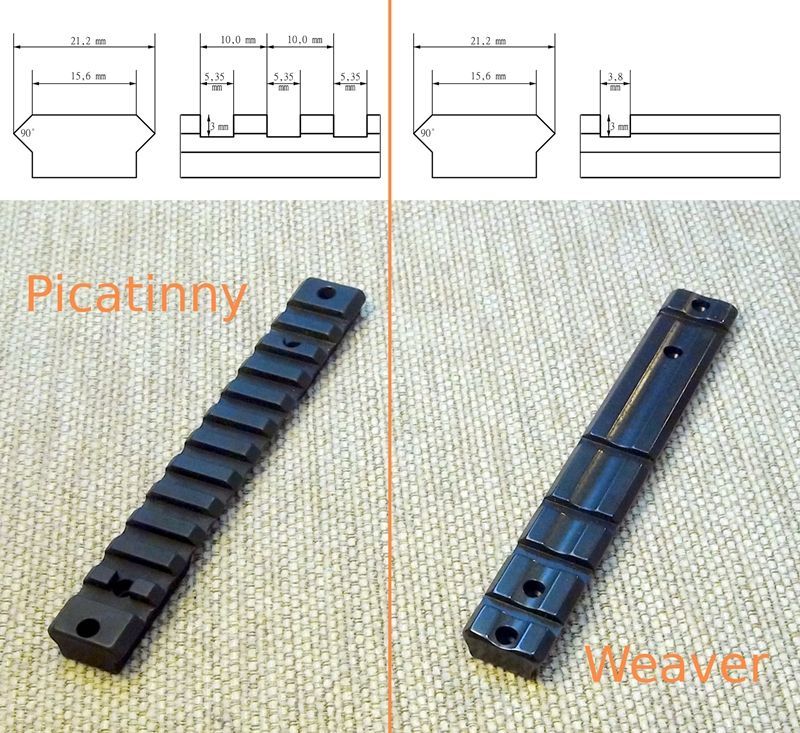
Picatinny Rail and Weaver rail profile

Design

The Picatinny rail is almost exclusively crafted from a single piece of metal (in some cases aluminum). In this manner, the axis of the Picatinny rail is perfectly straight and aligned with the axis of the firearm. Therefore the rifle scope which is mounted onto this kind of configuration is certainly aligned with the rifle / gun and the trajectory of the ammunition.

Weaver rail design on the other hand is usually manufactured in two separate pieces, greatly increasing the possibilities for the axis to be crooked, overlapping, and out of line.

It is always harder to align two separate pieces to a third line than it is to align one piece to another. In this way, the lapping of two mounting rings on a single-piece Picatinny rail is no longer required.

The single-piece rail will assure that both rings are perfectly aligned to each other and that no unwished stress is transferred to the riflescope.  

Picatinny compare to Weaver Rail

The Picatinny rail itself is an evolutionary step forward from the older Weaver rail. The main difference between Picatinny rail and Weaver rail is the spacing of the slots. Picatinny rail design has them evenly placed exactly 5.23 mm from one slot to the other, 3 mm deep. For this reason, the mounting options are repeatable and the same as other firearms using the Picatinny rail standard.

Interchangeability was a major driving force in the development of the new standard as different NATO armies need to be compatible with each other.

Weaver rail has 3.8mm wide slots and these slots can be placed anywhere on the Weaver rail and in any number that the producer wished.

Advantages of Picatinny design

A big advantage for using the Picatinny rail design is the ever-present recoil stop. Furthermore, the manufacturing of the rail is not very technically demanding and can be done without the use of state-of-the-art machines which greatly reduces the cost of the finished product, making it very affordable.

The Picatinny rail is easy to mount and usually, this type of configuration does not transfer negative stresses and forces from the fired weapon to the rifle scope.

In addition, the Picatinny rail with its very long useable surface works well for mounting longer rifle scopes or to achieve optimum eye relief.

The durability and toughness are other big pluses for this solution.

Manufacturers of Popular Models

A majority of the Picatinny rings are fixed, but a number of best rated European manufacturers (EAW, MAK,..) have, in recent years, put a lot of effort into the development of detachable ring with100% repeatability, with which it becomes easy to remove the scope from the weapon without the use of tools.

No re-zeroing is needed with such mount options, but these models tend to be expensive. 

Weaver and Picatinny Rings

Picatinny rail and weaver rail share one more thing. It is possible to use the Weaver ring and the Picatinny ring on the Picatinny-rails, but it is usually impossible to use the Picatinny ring on the Weaver base. The reason being the above-mentioned positioning and spacing of the slots.

  • Picatinny mounts have a 5mm recoil stop that goes into the rail slot and since
  • Weaver rail only has 3.8mm wide slots such rings do not fit on Weaver rails.

Due to this reason, the Picatinny-rails are popular and prevailing on the market in recent years and eventually, these options will completely oust the Weaver rail from the market.