Close

Knight LK93

The History of Knight

Not to be confused with the Knight’s Armament company or (KAC), the story of Knight America’s Muzzleloader began in 1985 when Tony Knight, a well renowned gunsmith at the time, opened his first shop in Putnam County, Missouri. Initially, he built the guns by hand, so every piece that came out of his workshop was customized and personalized for the end users. Over the years, the demand for his rifles increased significantly, leading to the opening of the first factory in 1987 and soon later they expanded production by opening another factory located in Iowa.

Over the years, Knight has introduced numerous models such as the LK 93, T-Bolt, the MK line, the Mountaineer etc. The company has also won the National Muzzleloading Rifle Associations “Manufacturers Accuracy Competition” 6 years in a row. Their muzzleloaders were and still are known to be one of the most accurate on the market.

In 1991, Dale and Bruce Watley bought the company, which was later acquired by Pradco in 1999. After a decline in sales, Knight Rifles ceased production in 2009, but was purchased by Plastic Industries in 2011 and is now based in Athens, Tennessee. They still offer various muzzleloader models and other equipment on their website.

Knight LK93 Muzzleloader Review

The Knight LK93 is a muzzleloader manufactured by Knight company. It comes with a removable stainless steel breech plug and is equipped with the Knight ACCU-LITE trigger system, allowing for weight of pull adjustments. Some models provide options for sear engagement and over-travel adjustments as well. It comes pre-set at the pull weight of approximately 1588 g (3.5 lbs).

The safety mechanism of the LK93 comes in the form of a lever on the right upper side of the receiver. In the rear position, the safety mechanism blocks the trigger and locks the hammer. The front position of the safety makes the weapon ready to fire and shows an indicator above a red dot on the rifle stock.

The ramrod is located below the barrel. For mounting purposes, the top side of the receiver has five drilled and tapped holes. The ignition system is in-line, and the muzzleloader features a removable one-piece hammer assembly. It comes with a front ramp and bead along with an adjustable rear hunting sight.

Multiple stock configurations are available, such as black, Mossy Oak TreeStand or Break-Up, Realtree X-tra Brown, and Bill Jordan’s Advantage. Additionally, the LK93 is fitted with sling swivels and a rubber recoil pad.

Knight LK93, chambered for .50 Cal.

Figure 1: Knight LK93, chambered for .50 Cal. (Source: https://www.marshallbid.com/auctions/8018/lot/15945-black-powder-knight-lk-93-rifle-50-cal-sn-s107836)

Knight LK93 Calibers

Knight LK93 can be chambered for the following calibers:

  • .50 cal.

The W209 shotshell primers are recommended for the ignition system on the LK93.

Knight LK93 Variants

The rifle is available in the following variants:

  • Knight LK93 Mossy Oak TreeStand

  • Knight LK93 Break-Up

  • Knight LK93 Realtree X-tra Brown

  • Knight LK93 Bill Jordan’s Advantage 

The receivers of Knight LK93 come with five holes for scope mounting purposes. There are two holes at the front and three at the rear end of the receiver.

The receiver of Knight LK93, chambered for .50 Cal.

Figure 2: The receiver of Knight LK93, chambered for .50 Cal. (Source: https://ctfirearmsauction.com/auction_item/knight-lk-93-50-cal-bp-muzzle-loader-rifle/)

A: 12.8 mm

B: 55.4 mm

C: 12.8 mm

C1: 12.8 mm

BHU: 0 mm

Ø: 6-48

Scope Mounts Interchangeable With Knight LK93

Rifles That Have One-Piece Scope Mounts Interchangeable With Knight LK93

For one-piece mounts to fit on a rifle, mounting surfaces on these rifles must match in every dimension. Firearms that share one-piece scope mounts with Knight LK93 are the following:

Rifles That Have Two-Piece Scope Mounts Interchangeable With Knight LK93

To meet interchangeability conditions, two-piece mounts must match in all dimensions except the B distance. B distance can vary because two-piece mounts can be installed and adjusted closer or further apart. Firearms that share two-piece scope mounts with Knight LK93 are the following:

Should you happen to own this rifle and would be willing to share with us more information regarding interchangeability, we kindly ask you to contact us at [email protected]

Thank you for your help!

Best Scope Mounts for Knight LK93

Weaver Bases for Knight LK93

These Weaver bases are produced by the American manufacturer Leupold. They are milled from a high-quality aluminum and designed to fit onto the receiver of your Knight LK93 perfectly.

Help Us Build Our Riflescope Mounts Database

If you happen to own this or any other rifle, we would appreciate it if you could help us expand our database by sending us some photos of the rifle receiver (the bare mounting surface of the rifle without the scope mounts installed). For your help, our company offers a fair return in terms of practical rewards.

Please send us an email for more information. You can contact us here: [email protected]

Filters
Sort
2 Items
Show
per page
Close
Sort By
In stock
As low as NOK 719.40
In stock
NOK 719.40
Filters
Sort
2 Items
Show
per page
Close
Sort By

VIDEO

Introduction

In recent years we can observe that a trend of Picatinny rail has become widespread and global. It is driven by the NATO standardized rails, more commonly known as the Picatinny rail standard. Picatinny rail being the New Jersey Arsenal that developed it in 1995.

These mounting options are revolutionary. The biggest and best advantage being that the Picatinny rail can be used its entire length and not bordered to a few pre-designed slots like for example the Weaver rail standard was before.

The other main advantage is the ease of use and interchangeability. If a product is meant for a Picatinny rail design it will fit all Picatinny-rails, no matter the manufacturer or date of production.

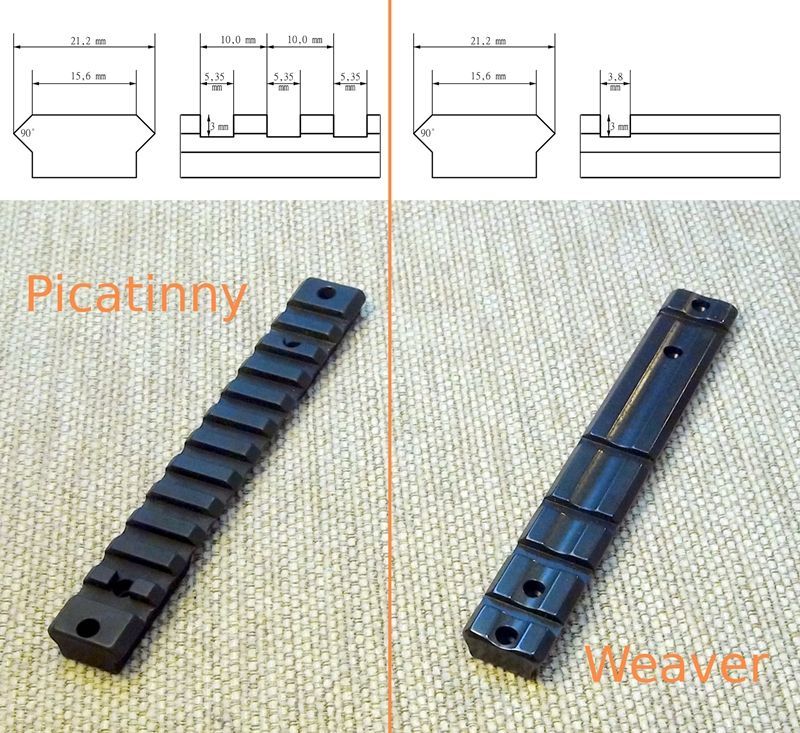
Picatinny/Weaver Rail

Picatinny Rail and Weaver rail profile

Design

The Picatinny rail is almost exclusively crafted from a single piece of metal (in some cases aluminum). In this manner, the axis of the Picatinny rail is perfectly straight and aligned with the axis of the firearm. Therefore the rifle scope which is mounted onto this kind of configuration is certainly aligned with the rifle / gun and the trajectory of the ammunition.

Weaver rail design on the other hand is usually manufactured in two separate pieces, greatly increasing the possibilities for the axis to be crooked, overlapping, and out of line.

It is always harder to align two separate pieces to a third line than it is to align one piece to another. In this way, the lapping of two mounting rings on a single-piece Picatinny rail is no longer required.

The single-piece rail will assure that both rings are perfectly aligned to each other and that no unwished stress is transferred to the riflescope.  

Picatinny compare to Weaver Rail

The Picatinny rail itself is an evolutionary step forward from the older Weaver rail. The main difference between Picatinny rail and Weaver rail is the spacing of the slots. Picatinny rail design has them evenly placed exactly 5.23 mm from one slot to the other, 3 mm deep. For this reason, the mounting options are repeatable and the same as other firearms using the Picatinny rail standard.

Interchangeability was a major driving force in the development of the new standard as different NATO armies need to be compatible with each other.

Weaver rail has 3.8mm wide slots and these slots can be placed anywhere on the Weaver rail and in any number that the producer wished.

Advantages of Picatinny design

A big advantage for using the Picatinny rail design is the ever-present recoil stop. Furthermore, the manufacturing of the rail is not very technically demanding and can be done without the use of state-of-the-art machines which greatly reduces the cost of the finished product, making it very affordable.

The Picatinny rail is easy to mount and usually, this type of configuration does not transfer negative stresses and forces from the fired weapon to the rifle scope.

In addition, the Picatinny rail with its very long useable surface works well for mounting longer rifle scopes or to achieve optimum eye relief.

The durability and toughness are other big pluses for this solution.

Manufacturers of Popular Models

A majority of the Picatinny rings are fixed, but a number of best rated European manufacturers (EAW, MAK,..) have, in recent years, put a lot of effort into the development of detachable ring with100% repeatability, with which it becomes easy to remove the scope from the weapon without the use of tools.

No re-zeroing is needed with such mount options, but these models tend to be expensive. 

Weaver and Picatinny Rings

Picatinny rail and weaver rail share one more thing. It is possible to use the Weaver ring and the Picatinny ring on the Picatinny-rails, but it is usually impossible to use the Picatinny ring on the Weaver base. The reason being the above-mentioned positioning and spacing of the slots.

  • Picatinny mounts have a 5mm recoil stop that goes into the rail slot and since
  • Weaver rail only has 3.8mm wide slots such rings do not fit on Weaver rails.

Due to this reason, the Picatinny-rails are popular and prevailing on the market in recent years and eventually, these options will completely oust the Weaver rail from the market.