Close

CZ 511

About the CZ

CZ firearms or CZ (which stands for Česká zbrojovka) is based in Uhersky Brod, a small town in the southeastern Czech Republic. CZ has its start in 1936 as a subsidiary of CZ Strakonice, which was itself a subsidiary of Zbrojovka Brno. The arms industry was growing quickly in Czechoslovakia at the time, and Uhersky Brod was chosen since it was secluded and lay beyond the range of German bombers, which, in case of an invasion, would target the arms factories first. The factory initially mostly produced pistols and small-caliber rifles; however, when German forces occupied Czechoslovakia in 1939, the company was renamed to Böhmische Waffenwerke and was forced to make machine guns, such as LK-30 and MG-17, for the German military.

After the end of World War II, the Soviets gained control of the region and the company was nationalized by the communist government, producing air weapons, machine guns, submachine guns, motorcycle and sewing machine parts. In 1957 the company started production of the Model 58, and in 1961 they introduced the world-famous Model 61 Škorpion machine pistol. The year 1975 marked the release of yet another popular model, the CZ 75 pistol which many manufacturers have since used as basis for their own products.

CZ once again became an independent company in 1992 following the fall of the Soviet Union. In the decades after, they have continued production of a variety of weapons seizing the market of law enforcement and military firearms with service pistols, assault rifles and grenade launchers with which they also helped equip the Czech army. They have strived to widen their presence on the international markets, opening a facility for assembly and repairs of CZ pistols in Peru and spreading production of their firearms (certain models of the CZ-P10 pistol) to the United States in 2019. As of 2021 they employed around 1500 workers.

CZ 511 Rifle Review

The CZ 511, a semi-automatic rimfire rifle, is a slightly improved version of the older Brno 581 which had previously been produced since the 1950s; the different name reflects the rebranding of Brno to CZ. The rifle features a cold hammer-forged threaded barrel and all-steel construction. The safety is a push-through catch at the rear of the trigger guard. The magazine release catch is located between the magazine and the trigger-guard and is activated by pushing it forward. The large capacity 8-round magazine is unusually wedge-shaped which makes it harder to adapt other magazines to CZ 511. The rifle was discontinued in 2010 when it was replaced by CZ 512.

CZ 511

Figure 1: CZ 511 .22 LR. Source: https://simpsonltd.com/cz-511-z48068/#gallery-1

CZ 511 is chambered for the following caliber:

  • .22 LR

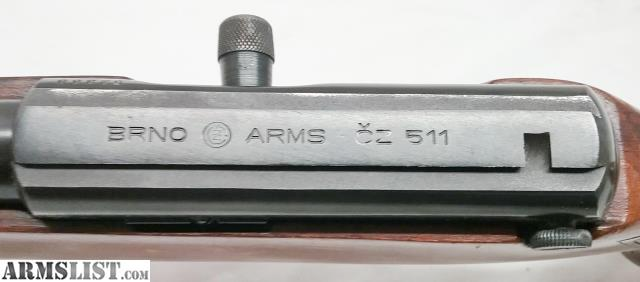
CZ 511 comes with an 11 mm dovetail with a recoil notch. The dovetail is flat on top.

CZ 511

Figure 2: CZ 511 receiver. Source: https://www.armslist.com/posts/13320906/eugene-oregon-rifles-for-sale--brno-arms---cz-511---made-in-czechoslovakia----22lr-stk--c182

CZ 511

Figure 3: CZ 511 receiver

A: /
B: /
C: /
D: 11 mm
BHU: 0 mm
Ø: /
R1: Prisma 11
R2: Prisma 11

Which rifles have interchangeable mounts

Two-piece mounts

For two-piece mounts to be interchangeable the mounting surfaces of the rifles must match in every dimension except the action length which can vary. This is because the distance between the two pieces of the mount is not fixed. If the mount has a recoil stopper, it must fit the recoil notch on the receiver. Rifles that have two-piece mounts interchangeable with CZ 511 are the following:

  • CZ 452 (11 mm)
  • CZ 453 (11 mm)
  • CZ 455
  • CZ 457
  • CZ 512
  • CZ 513

One-piece mounts

The necessary condition for rifles to have one-piece mounts interchangeable is that the mounting surfaces of these rifles match in every dimension. Rifles that have one-piece mounts interchangeable with CZ 511 are the following:

  • CZ 452 (11 mm)
  • CZ 453 (11 mm)
  • CZ 455
  • CZ 457
  • CZ 512
  • CZ 513

Our recommendations for mounts

Fixed mounts

This is the only one-piece mount available for CZ 511 and it is made by Kozap. Kozap is also from the Czech Republic, so their Slip-on mount is a great fit for CZ 511.

Detachable repeatable mounts

There are not a lot of detachable repeatable mounts available for CZ 511, but these roll-off rings from Rusan are a good choice in terms of price and quality.

Picatinny rails

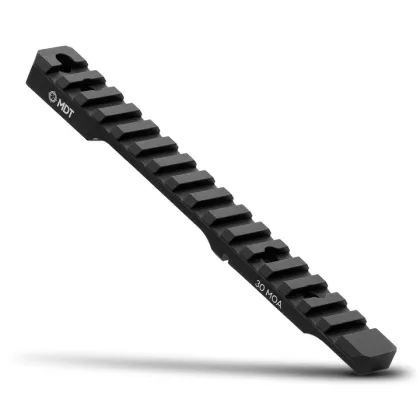
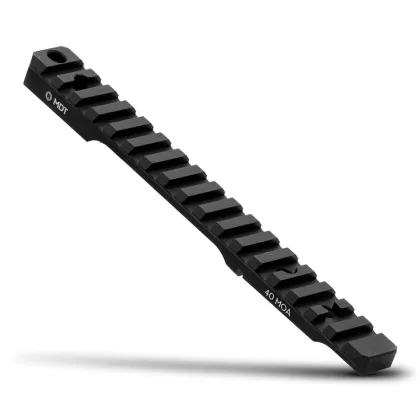
This Picatinny rail is a good choice in terms of price and quality.

Help us build our riflescope mounts database

If you happen to own this or any other rifle, we would appreciate it if you could help us expand our database by sending us some photos of the rifle receiver (the bare mounting surface of the rifle without the mounts installed). For your help, our company offers a fair return in terms of practical rewards. 

Please send us an email for more information. You can contact us here: [email protected]

Filters
Sort
34 Items
Show
per page
Close
Sort By
  1. In stock
  2. Out of stock
  1. Cheapest in stock
3D model
In stock
NOK 1,178.75
3D model
In stock
NOK 789.44
In stock
NOK 973.28
In stock
NOK 973.28
In stock
As low as NOK 1,016.54
In stock
NOK 973.28
In stock
NOK 973.28
In stock
NOK 973.28
In stock
As low as NOK 973.28
In stock
NOK 973.28
In stock
As low as NOK 1,135.49
In stock
NOK 973.28
In stock
NOK 616.41
In stock
As low as NOK 1,135.49
In stock
NOK 973.28
In stock
NOK 443.38
In stock
NOK 1,135.49
In stock
NOK 702.93
In stock
NOK 702.93
In stock
NOK 973.28
In stock
NOK 1,135.49
In stock
NOK 702.93
In stock
NOK 702.93
In stock
NOK 973.28
In stock
NOK 702.93
In stock
NOK 702.93
In stock
NOK 702.93
In stock
NOK 702.93
In stock
NOK 702.93
In stock
NOK 702.93
In stock
NOK 702.93
In stock
NOK 616.41
In stock
NOK 313.61
In stock
NOK 702.93
Filters
Sort
34 Items
Show
per page
Close
Sort By

VIDEO

Introduction

In recent years we can observe that a trend of Picatinny rail has become widespread and global. It is driven by the NATO standardized rails, more commonly known as the Picatinny rail standard. Picatinny rail being the New Jersey Arsenal that developed it in 1995.

These mounting options are revolutionary. The biggest and best advantage being that the Picatinny rail can be used its entire length and not bordered to a few pre-designed slots like for example the Weaver rail standard was before.

The other main advantage is the ease of use and interchangeability. If a product is meant for a Picatinny rail design it will fit all Picatinny-rails, no matter the manufacturer or date of production.

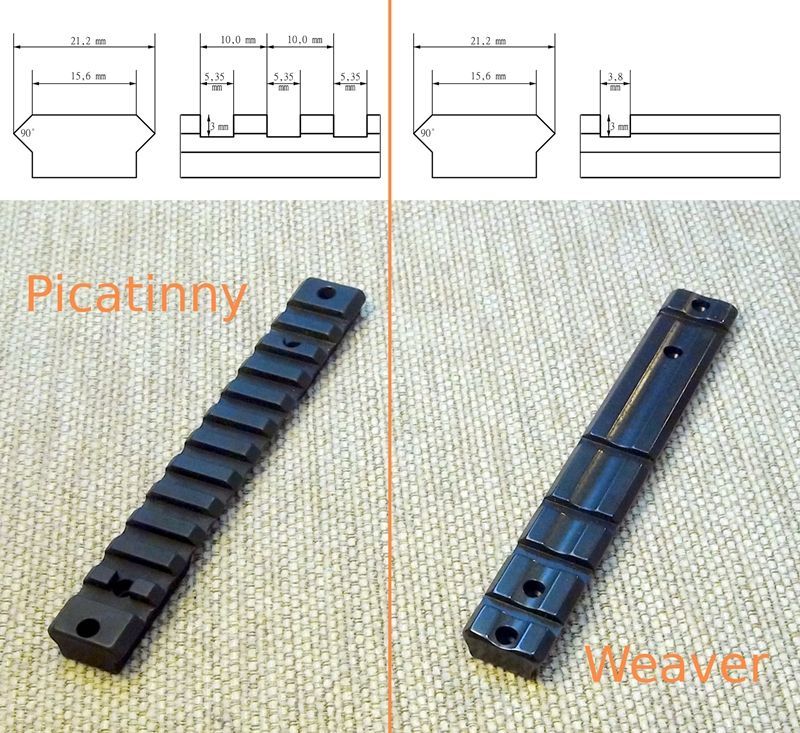
Picatinny/Weaver Rail

Picatinny Rail and Weaver rail profile

Design

The Picatinny rail is almost exclusively crafted from a single piece of metal (in some cases aluminum). In this manner, the axis of the Picatinny rail is perfectly straight and aligned with the axis of the firearm. Therefore the rifle scope which is mounted onto this kind of configuration is certainly aligned with the rifle / gun and the trajectory of the ammunition.

Weaver rail design on the other hand is usually manufactured in two separate pieces, greatly increasing the possibilities for the axis to be crooked, overlapping, and out of line.

It is always harder to align two separate pieces to a third line than it is to align one piece to another. In this way, the lapping of two mounting rings on a single-piece Picatinny rail is no longer required.

The single-piece rail will assure that both rings are perfectly aligned to each other and that no unwished stress is transferred to the riflescope.  

Picatinny compare to Weaver Rail

The Picatinny rail itself is an evolutionary step forward from the older Weaver rail. The main difference between Picatinny rail and Weaver rail is the spacing of the slots. Picatinny rail design has them evenly placed exactly 5.23 mm from one slot to the other, 3 mm deep. For this reason, the mounting options are repeatable and the same as other firearms using the Picatinny rail standard.

Interchangeability was a major driving force in the development of the new standard as different NATO armies need to be compatible with each other.

Weaver rail has 3.8mm wide slots and these slots can be placed anywhere on the Weaver rail and in any number that the producer wished.

Advantages of Picatinny design

A big advantage for using the Picatinny rail design is the ever-present recoil stop. Furthermore, the manufacturing of the rail is not very technically demanding and can be done without the use of state-of-the-art machines which greatly reduces the cost of the finished product, making it very affordable.

The Picatinny rail is easy to mount and usually, this type of configuration does not transfer negative stresses and forces from the fired weapon to the rifle scope.

In addition, the Picatinny rail with its very long useable surface works well for mounting longer rifle scopes or to achieve optimum eye relief.

The durability and toughness are other big pluses for this solution.

Manufacturers of Popular Models

A majority of the Picatinny rings are fixed, but a number of best rated European manufacturers (EAW, MAK,..) have, in recent years, put a lot of effort into the development of detachable ring with100% repeatability, with which it becomes easy to remove the scope from the weapon without the use of tools.

No re-zeroing is needed with such mount options, but these models tend to be expensive. 

Weaver and Picatinny Rings

Picatinny rail and weaver rail share one more thing. It is possible to use the Weaver ring and the Picatinny ring on the Picatinny-rails, but it is usually impossible to use the Picatinny ring on the Weaver base. The reason being the above-mentioned positioning and spacing of the slots.

  • Picatinny mounts have a 5mm recoil stop that goes into the rail slot and since
  • Weaver rail only has 3.8mm wide slots such rings do not fit on Weaver rails.

Due to this reason, the Picatinny-rails are popular and prevailing on the market in recent years and eventually, these options will completely oust the Weaver rail from the market.