Close

Sauer 100

About the Sauer

The story of Sauer & Sohn company began way back in the year 1751. The company was founded by Lorenz Sauer in the German city Suhl and until today it still lives up to its reputation as the oldest firearms manufacturing company in Germany. At its very beginnings, the company predominantly focused on producing firearms based on military contracts. The ‘Seven Years War’ in 1753 resulted in the company's first larger orders for the Prussian army.

Almost ninety years later, the eponymous grandson of Johann Paul Sauer started his business unit and around the same time, in 1839, the company changed its name to Spangenberg & Sauer. After the death of co-owner Ferdinand Spangenberg in 1873, Johann Paul Sauer, together with his sons Rudolf and Franz, took over the majority ownership of the company and re-named it to ‘J.P. Sauer & Sohn’. Soon after, the company reached its highest order to that point - approximately 150.000 rifles were produced for the German army. However, the number of military orders decreased severely in the following years, thus forcing the company to find new ways of expanding its market.

As the middle class grew, the demand for civilian arms production increased. The company knew how to exploit this economic situation and consequently presented its first SBS rifle in 1881, followed by the first catalogue which was released one year later. The innovativeness did not stop there – the company's success was at its very beginning, to say the least. As it grew, it began to gradually focus on hunting rifles. Thereupon, the first Sauer self-cocking drilling with a separate cocking lever for the ball lock was presented and launched in 1895. Twenty years later, the company presented the Sauer Meisterwerk XVIII shotgun that boasted sear, single trigger, ejector and engraving by Franz Schilling.

During the First World War, they mostly re-focused on military production and expanded its establishment along with the number of staff. However, the social and economic penury after the war, made the company struggle in the following years. To ensure its survival, the company started producing various products such as typewriters under the name Fortuna; for a short period, they also manufactured bikes. Due to the prohibition of military production, the construction of light hunting rifles was launched in 1930 with the triplet Mod. 30 and Mod. 30 L being introduced the same year and Mod. 32, Mod 32 L, Mod. 33 shortly after.

The shift in production happened again at the beginning of the Second World War when orders for military purposes firearms were increased. After the War, being deleted from the commercial register and under total soviet occupation, the company continued its production under different names - 'VEB FORTUNA Werk Suhl' and later 'VEB MEWA Ernst-Thälmann-Werke Suhl'. At that point, Rolf Sauer sold all company's rights to a group of industrialists in FRG. Nonetheless, the company still used its original name J.P. Sauer & Sohn for the production of hunting rifles years later. In 1951 J.P Sauer & Sohn GmbH was founded as the first hunting rifles manufacturer in FRG.

Soon after some of the most recognizable models were presented, such as Drilling Model 3000, which replaced the famous S53 Drilling, Model 80 bolt action rifle, Sauer 200 (the first modular action rifle in 14 calibres), the S 200 and Sauer 202.

After the year 2000, the ownership changed again when passionate hunters Michael Lüke and Thomas Ortmeier took over. At that turning point, the company shifted to focusing exclusively on the production of hunting rifles, presenting several popular models such as SAUER 303 self-loading rifle, SAUER 101, SAUER 202, SAUER 404, SAUER 404 Synchro XTC, SAUER 100, Sauer S 100, SAUER SL5 and SAUER101 Highland XTC. Nowadays, the brand's vivacious history and tradition of over 270 years result in quality and experience, thus offering an infallible choice for every hunting enthusiast.

Sauer 100 Rifle Review

Sauer 100 is a push feed bolt-action repeater rifle and one of the most affordable variants of the 100 series. The forged-steel receiver has sloped sides and houses three locking lugs which are milled into the barrel breaches themselves. The 3-position thumb-operated safety catch offers practical and comfortable use. Contrary to S 101, the barrel is attached via threading.

The 60-degree lift type bolt sits flush with the tang and receiver in the closed position. Smooth and adjustable single-stage trigger sees to even greater shooting experience and can be fine-tuned using the Allen key which is supplied with the rifle. Variants 100 STAINLESS XTA and S 100 FIELDSHOT come with the height-adjustable comb to fine-tune the eye level behind the scope.

Additionally, there are some key surface differences between S 100 and S 101.

Sauer 100 uses Cerakote coating technology on their barrels, the wooden stock is made of DURA beech. XT variants come with rugged polymer stock, that is not coated.

Sauer 101 uses a phosphate conversion coating on their barrels and the wooden stock is made of walnut (Juglans wood). XT variants, that come with rugged polymer stock are also covered in Soft Touch Coating which adds to the silent handling of the rifle. 

Depending on the calibre and variants, barrel lengths are 560 mm (22-inch) & 620 mm (24-inch)

Sauer 100

Figure 1: Sauer 100, chambered for .308. Win (Source: https://www.rifleshootermagazine.co.uk/rifle-tests/sauer-100-classic-xt-in-308-win-in-depth-rifle-6269596)

Sauer 100 can be chambered for the following calibres:

  • .223 Rem.
  • .243 Win.
  • 6.5mm Creedmoor
  • 6.5 PRC
  • 6.5x55 SE
  • .270 Win.
  • 7mm-08 Rem.
  • 7mm Rem. Mag.
  • .30-06 Spr.
  • .300 Win. Mag.
  • .308 Win.
  • 8x57 JS
  • 9.3x62 

Calibre choice depends on the variant.

  • S 100 Classic
  • S 100 Classic XT*
  • S 100 Stainless XTA*

XT variants come with a polymer stock.

All Sauer 100 receivers come with four holes for mounting purposes, two on the front and two on the rear mounting surface.

Sauer 100

Figure 2: The receiver of Sauer 100

Sauer 100

A: 21.9 mm

B: 113.9 mm

C: 15.3 mm

BHU: 2.9 mm

Ø: 6-48

R1: R51

R2: R17

Which Rifles Have Interchangeable Mounts

Two-piece mounts

All the rifles listed in the category below have two-piece mounts interchangeable with Sauer 100. To meet interchangeability conditions, two-piece mounts must match in all dimensions except the B distance. B distance can vary because two-piece mounts can be installed and adjusted closer or further apart. Rifles that meet such criteria are:

  • Bergara B14 SA
  • Bergara Premier rifles – SA
  • Bergara B14 LA
  • Bergara Premier rifles – LA
  • Remington 700 SA
  • Remington 722
  • Remington 40x SA
  • Remington 40-XB
  • Remington 700 LA
  • Remington 721
  • Remington 725
  • Remington 40x LA
  • Mauser M18
  • Mauser M94
  • Mauser 1996 (Serial number < 12000)
  • Haenel Jaeger 10
  • Sauer 101
  • Remington 78 LA
  • Remington 78 SA
  • Mauser M12 (2019-onward)

One-piece mounts

All the rifles listed in the category below have one-piece mounts interchangeable with Sauer 100. For one-piece mounts to fit on a rifle, mounting surfaces on these rifles must match in every dimension. Rifles that share the same dimensions and mounting surface with Sauer 100 are:

  • Bergara B14 LA
  • Bergara Premier rifles – LA
  • Remington 700 LA
  • Remington 721
  • Remington 725
  • Remington 40x LA
  • Haenel Jager Jaeger Jäger 10
  • Sauer 101
  • Mauser M18
  • Remington 78 LA
  • Mauser M12 (2019-onward)

Our Recommendations for Mounts

Fixed Mounts

MAKfix is a two-piece mount solution that consists of rings with bases made of steel. Its compactness and durability make it an optimal choice for your Sauer 100 rifle.

Detachable Repeatable Mounts

There are quite a few detachable mounts to choose from when it comes to Sauer 100. However, we would recommend this one-piece ERAMATIC swing mount made by the German company Recknagel as it combines simplicity with functionality and price. Made from a light alloy, it is easy to install and offers infallible repeatability.

Picatinny Rails

When purchasing a Picatinny rail, the most important thing to pay attention to is the dimensions of the mounting surface. This high-quality, steel Picatinny rail made by the German company EAW is a reliable choice and will match perfectly with the receiver dimensions of your Sauer 100. Made from prime material, it comes with included screws and a channel grooved in the middle of the rail.

Help us build our riflescope mounts database

If you happen to own this or any other rifle, we would appreciate it if you could help us expand our database by sending us some photos of the rifle receiver (the bare mounting surface of the rifle without the mounts installed). For your help, our company offers a fair return in terms of practical rewards. 

Please send us an email for more information. You can contact us here: [email protected]

Filters
Sort
1 Item
Show
per page
Close
Sort By
In stock
Ask for price
Filters
Sort
1 Item
Show
per page
Close
Sort By

General features of Mono-block Scope Mounts

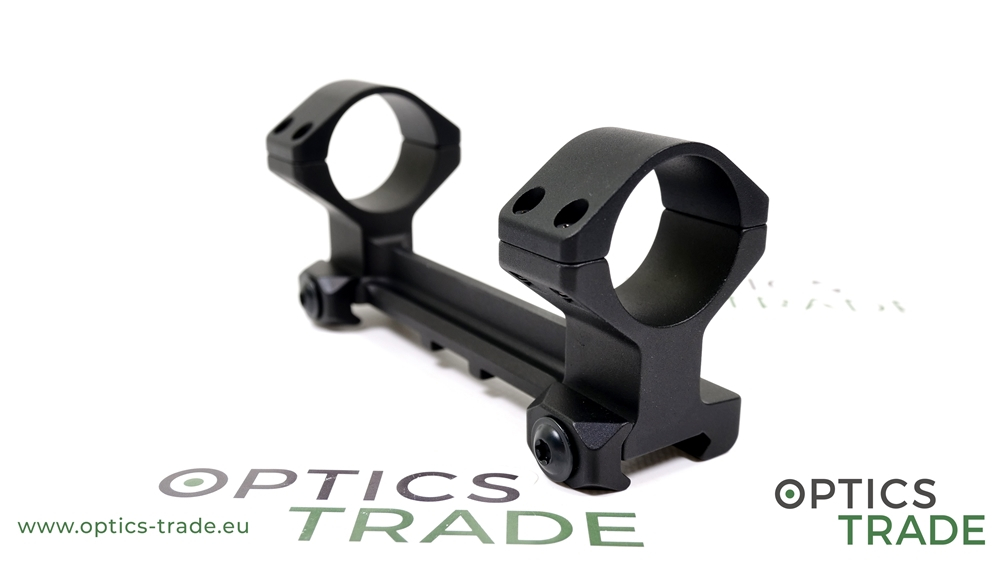
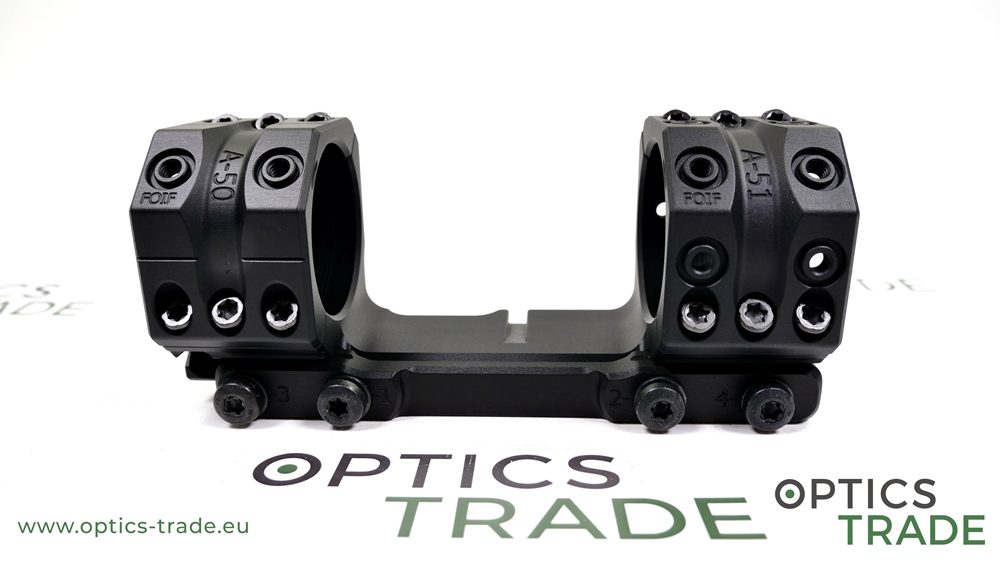
All of the mono-block scope mounts have in common that both scope rings are made of one piece of material. Making a whole mount of one piece of raw material is usually possible by milling. These mounts are normally made for tactical applications, because they can be used in the toughest conditions. They are normally made out of one piece of hiqh quality aluminium alloy (like 7075T6), because steel might be too heavy for such applications. Steel is normally used only with the screws or claws that hold scope mount onto the Picatinny rail. However, there are some manufacturers which make nice mono-block mounts for hunting applications also (Spuhr, ERA-TAC Ultralight, etc.).

This type of mounts is suitable for use on Picatinny rails. Although, there are other rail standards that are known as common practice: 11 mm (AI), 16.5 mm (Tikka, Sako TRG), 19 mm (CZ 550)... They can be quick detachable or fixed (however, most of them are fixed).

ERA-TAC Ultralight Mount for Picatinny, 30 mm

ERA-TAC Ultralight Mount for Picatinny, 30 mm

Mono-block mounts for tactical rifles

Mono-block mounts for tactical rifles might be nearly perfect to use and main reasons for that can be found in:

  • rigidness,

  • hardness,

  • durability,

  • reliability and

  • precision.

They offer perfect ring alignment which is the key to not damaging or flexing your scope. Large contact surface between the scope and the mount might also be a favourable factor. Lapping during the process of mounting the scope is not needed. In addition, bedding is also not needed. All of the text above is true if we are talking about mounts of proper quality.

On the other hand, you have to be prepared for a (usually) bulky appearance and less adjustable length for proper eye relief.


Other Features of Mono-block Scope Mounts

Tactical mono-block scope mounts, made of high quality, normally have more than just one recoil stopper.

Some of the manufacturers (like Spuhr) advise their customers to oil surfaces between their mount and Picatinny rail before the mounting of them. They also advise to use resin between rings and rifle scope.

Spuhr Unimount for Picatinny, 35mm, 6 MIL 20.6 MOA

Spuhr Unimount for Picatinny, 35mm, 6 MIL 20.6 MOA


A lot of mono-block mounts offer additional attachment points on their rings. These attachment points are normally used for red-dots, lasers, rangefinders, angle indicators, etc. Bubble levels are also common on these mounts (on the rear side of the mount – Tier One, Spuhr,...). These bubble levels are aligned with the Picatinny rail under them.

Practically all of tactical mono-block mounts use 6 – 8 screws for tightening the scope. It is very rare for such mounts to use only 4 screws. With tactical mounts, rings are normally divided 50:50 (upper and lower part of the ring, tightened with screws), which is different than with other, for example hunting mounts, where rings are divided in different ratio – for example 60:40 (upper / lower part of the ring). In this case, upper part is bigger than the lower part, which in practice means that scope is embraced by the upper part of the ring a little bit more.

Tactical mono-block mounts are the most common mount form with inclination. If mounts are made with inclination, it is usually:

  • 10 MOA,
  • 20 MOA or
  • 30 MOA.

These type of mounts are great for long range shooting, because they offer a whole new possibilities for long range shooters. Majority of the mono-block mounts with inclination, is 20 MOA. However, there are mounts up to 70 MOA on the market (for example: Era-Tac from Recknagel).