Close

Cooper Model 92

The History of Cooper

Cooper was established in 1990 by Dan Cooper and two former employees of Kimber of Oregon. Initially, the company focused on the production of hunting rifles, specifically those used for varmint hunting. Their initial product line included the Model 36 TRP-1, part of their Target Rifle Project-Phase 1, and the Model 38 in 22CCM, intended for sports shooting.

In 1993, they started testing a one-shot varmint rifle in .223 Remington, leading to the development of the three-lug bolt action Model 21 also known as "Varmint Extreme". In 1998, the company underwent a rebranding, adopting the name "Cooper Firearms of Montana, Inc." and marking its products accordingly. That year, they introduced Models 21 and 22, collectively known as "Varminter", and expanded their range with the Model 57, which later evolved into Model 57M in 2001. They also added new stock designs to their offer in 2005.

2007 marked the introduction of the Model 52, designed for use with .30-06 cartridges. However, 2008 was a challenging year for the company, with a controversy surrounding Dan Cooper's financial support to a pro-gun control presidential candidate Barack Obama. This resulted in Cooper stepping down from his CEO position. Following this period, the company continued to innovate with the release of models like the short action repeater Model 54 in 2009, and the Model 56, accommodating various magnum calibers, in 2010.

Fast forward to 2023, Nighthawk Custom of Arkansas acquired Cooper Firearms of Montana, and the production facilities were transferred to Arkansas, USA. In February 2023, Nighthawk communicated to Cooper customers that they had acquired Cooper's assets, including the brand name, intellectual properties, and inventory, after a team visit to Montana in December. They relocated these assets to Arkansas and are planning to manufacture new Cooper rifles there, with operations expected to start in late 2023.

Cooper Model 92 Rifle Review

The Cooper Model 92 is a bolt-action rifle featuring a lighter version of the Model 52's action. The three-lug locking system is consistent with other Cooper models, and the extractor operates on a spring-tensioned rotation. The ejection system, however, is different in the Model 92, having a spring-loaded plunger located at the front of the bolt, as opposed to the Model 52's pivoting-blade ejector in the receiver bridge. Except for differences in the caliber choice, other structural components remain on par with model 52.

The Model 92 features a 24-inch light contour barrel, made of stainless steel and fluted for lighter weight. The rifle comes with a detachable steel magazine, with a capacity of three rounds. Every model incorporates a bolt release lever located on the receiver's right side. The receiver is drilled and tapped to allow scope mounting, and some models are supplied with pre-installed mounting bases.

The safety mechanism comes in a form of a two-position safety lever, positioned on the side of the bolt handle. Pulling the lever rearward disables the trigger, but bolt operation is unaffected. Pushing the lever forward reveals a red dot on the indicator, signifying the rifle is cocked and ready to be fired.

The single-stage trigger mechanism includes adjustments for over-travel, sear engagement, and the weight of pull that ranges from 680 to 1814 grams (1.5-4 lbs). The 92 models are available in various stocks and different finishes.

Cooper Model 92, chambered for .300 Win. Mag.

Figure 1: Cooper Model 92, chambered for .300 Win. Mag. (Source: https://www.gunsinternational.com/guns-for-sale-online/rifles/cooper-arms-rifles/cooper-model-92-backcountry-rifle-300-win-mag.cfm?gun_id=101743336)

Cooper Model 92 Calibers

The rifle is available in the following calibers:

  • .240 Wby. Mag.

  • .270 Win.

  • .280 Ackley

  • 6.5-284 Norma

  • .264 Win. Mag.

  • 6.5-300 Wby. Mag.

  • 7mm Rem. Mag.

  • 7mm STW

  • .30-06 Spr.

  • .300 Win. Mag.

  • .338 Win. Mag.

  • .340 Wby. Mag.

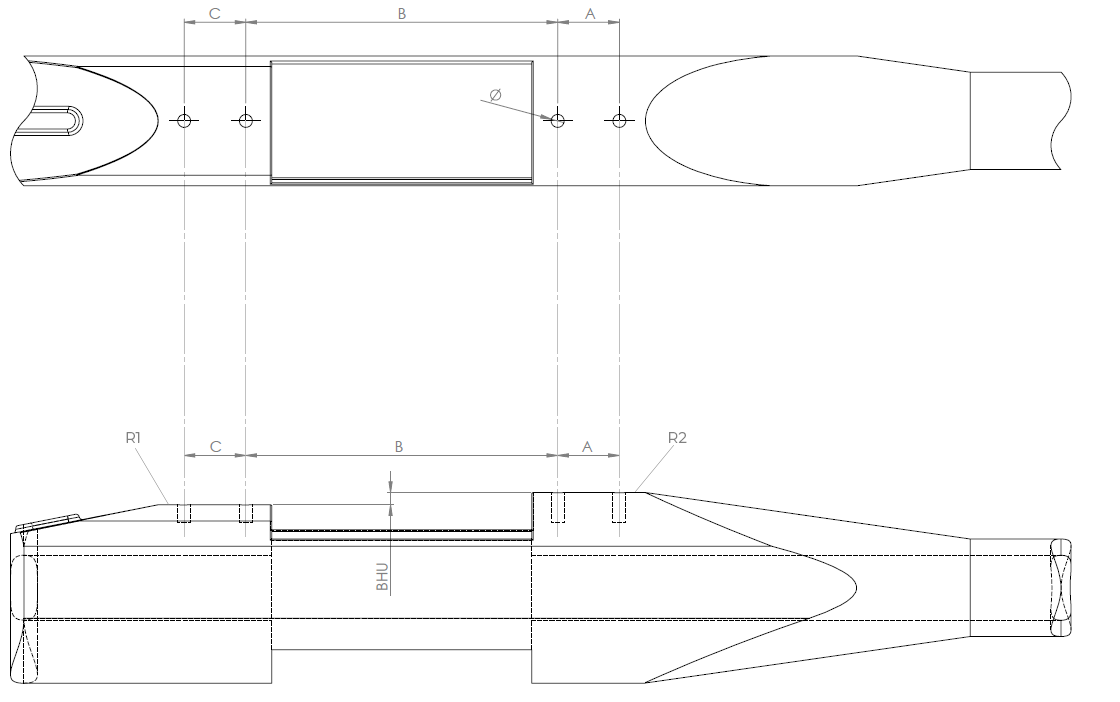
The receiver of model 92 comes with four holes that can be used for scope mounting purposes. There are two holes on the front and two on the rear mounting surface.

The receiver of Cooper Model 92, chambered for .300 Win. Mag.

Figure 2: The receiver of Cooper Model 92, chambered for .300 Win. Mag. (Source: https://www.gunsinternational.com/guns-for-sale-online/rifles/cooper-arms-rifles/cooper-model-92-backcountry-rifle-300-win-mag.cfm?gun_id=101743336)

Cooper Model 92

Unfortunately, we were unable to find a picture of the Cooper Model 92 receiver without pre-installed bases. Should you happen to own this rifle and would be willing to send us some photos of the bare mounting surface (without scope bases installed), we kindly ask you to contact us at [email protected]

Your help is greatly appreciated!

A: 21.8 mm

B: 103 mm

C: 12.7 mm

BHU: /

Ø: 6-48

R1: /

R2: /

Scope Mounts Interchangeable With Cooper Model 92

Rifles That Have One-Piece Scope Mounts Interchangeable With Cooper Model 92

For one-piece mounts to fit on a rifle, mounting surfaces on these rifles must match in every dimension. Rifles that share one-piece scope mounts with Cooper Model 92 are the following:

Since we cannot confirm the exact BHU height and radiuses of the front and back mounting surface on top of the receiver, we cannot provide you with the full list of rifles that have one-piece scope mounts interchangeable with Cooper Model 92. However, according to one scope manufacturer, the Picatinny rails for the 52 model should also fit onto the receiver of Model 92.

Rifles That Have Two-Piece Scope Mounts Interchangeable With Cooper Model 92

To meet interchangeability conditions, two-piece mounts must match in all dimensions except the B distance. B distance can vary because two-piece mounts can be installed and adjusted closer or further apart. Rifles that share two-piece scope mounts with Cooper Model 92 are the following:

Best Scope Mounts for Cooper Model 92

Fixed Scope Mounts for Cooper Model 92

If you are looking for a reliable fixed mounting solution for your Cooper Model 92, you might consider these Talley rings. They are made from high-quality aluminum alloy and come with a ten-year warranty.

Picatinny Rails for Cooper Model 92

When choosing a Picatinny rail, one should always keep an eye on the distance between the holes on the rail. This Talley Picatinny rail is an excellent choice as it matches the receiver of the Cooper Model 92 rifle.

Help Us Build Our Riflescope Mounts Database

If you happen to own this or any other rifle, we would appreciate it if you could help us expand our database by sending us some photos of the rifle receiver (the bare mounting surface of the rifle without the scope mounts installed). For your help, our company offers a fair return in terms of practical rewards.

Please send us an email for more information. You can contact us here: [email protected]

Filters
Sort
2 Items
Show
per page
Close
Sort By
In stock
CA$105.32
In stock
CA$105.32
Filters
Sort
2 Items
Show
per page
Close
Sort By

VIDEO

Introduction

In recent years we can observe that a trend of Picatinny rail has become widespread and global. It is driven by the NATO standardized rails, more commonly known as the Picatinny rail standard. Picatinny rail being the New Jersey Arsenal that developed it in 1995.

These mounting options are revolutionary. The biggest and best advantage being that the Picatinny rail can be used its entire length and not bordered to a few pre-designed slots like for example the Weaver rail standard was before.

The other main advantage is the ease of use and interchangeability. If a product is meant for a Picatinny rail design it will fit all Picatinny-rails, no matter the manufacturer or date of production.

Picatinny/Weaver Rail

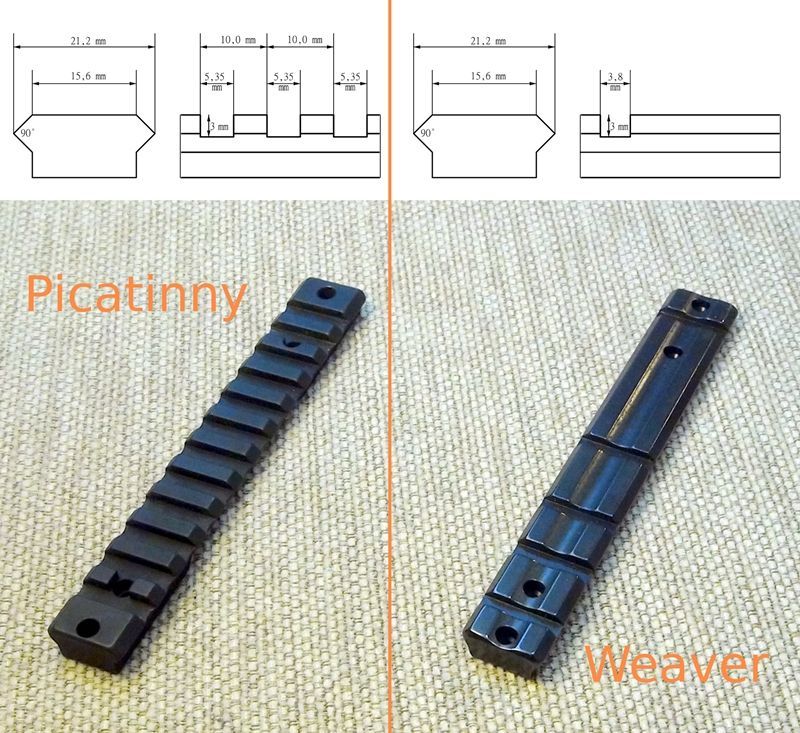
Picatinny Rail and Weaver rail profile

Design

The Picatinny rail is almost exclusively crafted from a single piece of metal (in some cases aluminum). In this manner, the axis of the Picatinny rail is perfectly straight and aligned with the axis of the firearm. Therefore the rifle scope which is mounted onto this kind of configuration is certainly aligned with the rifle / gun and the trajectory of the ammunition.

Weaver rail design on the other hand is usually manufactured in two separate pieces, greatly increasing the possibilities for the axis to be crooked, overlapping, and out of line.

It is always harder to align two separate pieces to a third line than it is to align one piece to another. In this way, the lapping of two mounting rings on a single-piece Picatinny rail is no longer required.

The single-piece rail will assure that both rings are perfectly aligned to each other and that no unwished stress is transferred to the riflescope.  

Picatinny compare to Weaver Rail

The Picatinny rail itself is an evolutionary step forward from the older Weaver rail. The main difference between Picatinny rail and Weaver rail is the spacing of the slots. Picatinny rail design has them evenly placed exactly 5.23 mm from one slot to the other, 3 mm deep. For this reason, the mounting options are repeatable and the same as other firearms using the Picatinny rail standard.

Interchangeability was a major driving force in the development of the new standard as different NATO armies need to be compatible with each other.

Weaver rail has 3.8mm wide slots and these slots can be placed anywhere on the Weaver rail and in any number that the producer wished.

Advantages of Picatinny design

A big advantage for using the Picatinny rail design is the ever-present recoil stop. Furthermore, the manufacturing of the rail is not very technically demanding and can be done without the use of state-of-the-art machines which greatly reduces the cost of the finished product, making it very affordable.

The Picatinny rail is easy to mount and usually, this type of configuration does not transfer negative stresses and forces from the fired weapon to the rifle scope.

In addition, the Picatinny rail with its very long useable surface works well for mounting longer rifle scopes or to achieve optimum eye relief.

The durability and toughness are other big pluses for this solution.

Manufacturers of Popular Models

A majority of the Picatinny rings are fixed, but a number of best rated European manufacturers (EAW, MAK,..) have, in recent years, put a lot of effort into the development of detachable ring with100% repeatability, with which it becomes easy to remove the scope from the weapon without the use of tools.

No re-zeroing is needed with such mount options, but these models tend to be expensive. 

Weaver and Picatinny Rings

Picatinny rail and weaver rail share one more thing. It is possible to use the Weaver ring and the Picatinny ring on the Picatinny-rails, but it is usually impossible to use the Picatinny ring on the Weaver base. The reason being the above-mentioned positioning and spacing of the slots.

  • Picatinny mounts have a 5mm recoil stop that goes into the rail slot and since
  • Weaver rail only has 3.8mm wide slots such rings do not fit on Weaver rails.

Due to this reason, the Picatinny-rails are popular and prevailing on the market in recent years and eventually, these options will completely oust the Weaver rail from the market.